
Government AI “GENAI”
- Last Updated:
(The image shows the GENAI environment: utilizing generative AI to make government operations more efficient.)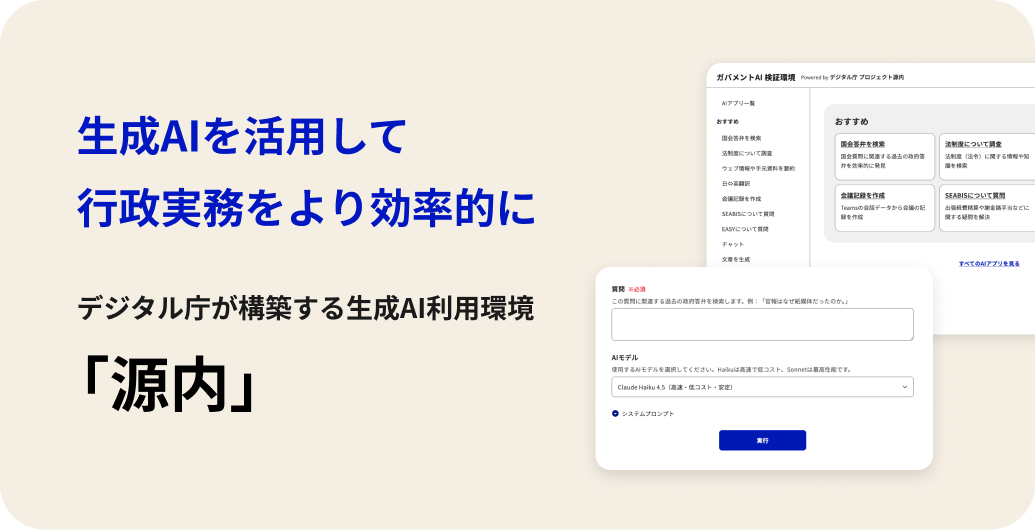
Overview
Government AI serves as the foundation that enables government employees to utilize AI in a safe and secure manner. As an initial measure, the Digital Agency is rolling out "GENAI (Derived from Generative AI. Pronounced GENNAI)," an environment for utilizing generative AI, to all ministries and agencies.
Based on the "Act on the Promotion of Research and Development, and Utilization of AI-Related Technology (AI Act)" (Cabinet Office) enacted in May 2025 and the subsequent "Artificial Intelligence Basic Plan" (Cabinet Office) approved by the Cabinet in December, the government has established a policy to lead the way in AI utilization, following the principle of "leading by example." By ensuring that AI use becomes common practice and well established among government employees, the government aims to enhance the quality and efficiency of its operations.
To enable the government to lead in AI utilization, the Digital Agency is implementing an environment for utilizing generative AI. During fiscal year 2026, approximately 180,000 government employees across all ministries and agencies are expected to have access to generative AI.
Alongside these efforts, the Digital Agency is currently promoting the following initiatives to further accelerate AI utilization: the development of advanced AI applications; support for the development of domestic Large Language Models (LLMs); the preparation of common government datasets; and technical support for other ministries and agencies. In the future, we aim to further enhance the generative AI environment so that all government employees, including those in regional and local branch offices, can experience improvements in the quality of their work.
Table of Contents
- Recent Initiatives
- About Government AI "GENAI"
- Applications provided by "GENAI"
- Strategic Measures and Initiatives
- (1) Development and Deployment of the Generative AI Environment "GENAI"
- (2) Development of Advanced AI Applications
- (3) AI Support for the Development of Domestic Large Language Models (LLMs)
- (4) Development of Large-scale Datasets common within the government
- (5) Technical Support for Other Ministries and Agencies
- "GENAI" Rollout Schedule
- Reference Materials
- Councils and Committees
- Related Information
Recent Initiatives
Press Releases / Official Publications
Official updates and announcements regarding the Digital Agency's latest initiatives.
- Government AI GENAI Official Logo Released (July 29, 2026)
- Online Briefing on the Government AI GENAI OSS Ver 2.0 Plan (July 24, 2026)
- Government AI GENAI starts trial use of Domestic Foundation Models on a Domestic Cloud Platform (July 10, 2026)
- (Advance Notice) Call for Applications for Domestic Large Language Models (LLMs) for Use in Government AI Project(May 29, 2026)
- Launch of Large-Scale Pilot Project for “Government AI GENAI” Targeting 180,000 Employees Across All Ministries and Agencies(May 28, 2026)
- Release of Government AI "GENAI" as Open Source Software (OSS)(April 24, 2026)
- Launch of Large-Scale Pilot Project of Government AI "GENAI" targeting 180,000 Employees across all Ministries and Agencies(March 6, 2026)
- Results of the Public Call for Domestic Large Language Models (LLMs) for Trial Use in Government AI(March 6, 2026)(Japanese text)
- Public Call for Domestic Large Language Models (LLMs) for Trial Use in Government AI(December 2, 2025)(Japanese text)
- Launch of PLaMo Translate for Use in the Government AI Project "GENAI"(December 2, 2025)
- Collaboration with OpenAI for the Implementation of Government AI(October 2, 2025)(Japanese text)
- Materials related to Generative AI Usage by Digital Agency Employees(August 29, 2025)(Japanese text)
Explanatory Articles
Insights into the GENAI framework and its practical use cases (Please note that the attached documents are in Japanese.)
- Release of Government AI "GENAI" as Open Source Software (OSS) (Digital Agency News)(April 24, 2026)
- 【Explanation】What is Government AI? The Digital Agency’s AI Strategy for the Public Sector [GENAI] (Digital Agency News)(December 11, 2025)
- Introducing the Vision for Government AI and Project "GENAI" (Digital Agency Note)(November 11, 2025)
- AI for Local Government: Identifying Core Pain Points as the First Step(Co-Creation PF Camp Report)(November 7, 2025)
Featured Videos
These videos introduce what “GENAI” is, its framework, and the vision it aims to achieve.
- [Empowering all government employees to become "AI Engineers"] Rollout of GENAI to other ministries: A look at the Ministry of Land, Infrastructure, Transport and Tourism... [Government AI] (Digital Agency News YouTube)(March 2, 2026)
- [Government AI] What is the GENAI generative AI platform? A look behind the scenes of AI apps and systems specialized for administrative operations [Explanation] (Digital Agency YouTube)(February 12, 2026)
- [AI Utilization as a "Defensive War"] Finding the key to scaling local government success stories [Co-Creation PF Camp in Shikoku, Kagawa prefecture] (Digital Agency News YouTube)(January 15, 2026)
- [Turning all government employees into "AI Engineers"!?] What is "Government AI" shaping the future of administration? [GENAI Explanation] (Digital Agency News YouTube)(December 11, 2025)
- [In-house AI app development] Behind the scenes with the "AI Team" shaping the future of government administration [Toward building Government AI](Digital Agency News YouTube)(October 9, 2025)
- [Bringing AI utilization to local government employees] Co-Creation PF Camp at the Digital Agency [Promoting Local Government DX] (Digital Agency News YouTube)(August 14, 2025)
Trademark and Brand Guidelines
- ”Government AI GENAI” Trademark and Brand Guidelines(PDF / 679KB)(July 10, 2026)(Japanese text)
About Government AI "GENAI"
In Japan, there are growing concerns that maintaining public services will become difficult due to labor shortages driven by a rapid population decline and a shrinking, aging society with a low birthrate. To address these challenges and ensure the long-term sustainability and enhancement of public services, it is essential to maximize the potential use of AI, including generative AI.
Under these circumstances, and in accordance with the "Act on the Promotion of Research and Development, and Utilization of AI-Related Technology (AI Act)"(Cabinet Office), Japan is steadily establishing government structures to facilitate the use of AI in society. At the same time, the government has clarified its policy to lead by example in the safe and secure use of AI.
Furthermore, the "Priority Plan for the Realization of a Digital Society"(Cabinet Decision, June 13, 2025) emphasizes the necessity to promote AI deployment across society, improve productivity, and enhance service qualities. Based on this plan, the government has established a policy to build a government-wide AI infrastructure (Government AI) through in-house development by the Digital Agency. This initiative also includes the development and dissemination of government-held data to support broader AI utilization.
In accordance with the Digital Agency Establishment Act, the Policies and Strategies for AI powered Government Team within the Strategy and Organization Group is spearheading the implementation and promotion of generative AI across the government and related entities. In May 2025, the Digital Agency launched "GENAI," a generative AI platform developed entirely in-house for all its employees. Since then, the Digital Agency has been conducting verification at administrative sites by providing multiple specialized applications, such as “Diet Response Search AI" and a "Legal Research Support AI." These efforts have confirmed that generative AI is effective in enhancing the quality, efficiency, and labor-saving of administrative operations.
Based on these results, we will continue the operation of “GENAI” while expanding the generative AI environment across the government and related entities by sharing our proven results and expertise. Additionally, we are committed to fostering a sustainable ecosystem for Government AI through the collaboration and cooperation of stakeholders from industry, academia, and the public sector.
(The image is a summary of the GENAI platform: a secure, in-house AI environment for administrative operations for the government employees. Scheduled for government-wide rollout in 2026.)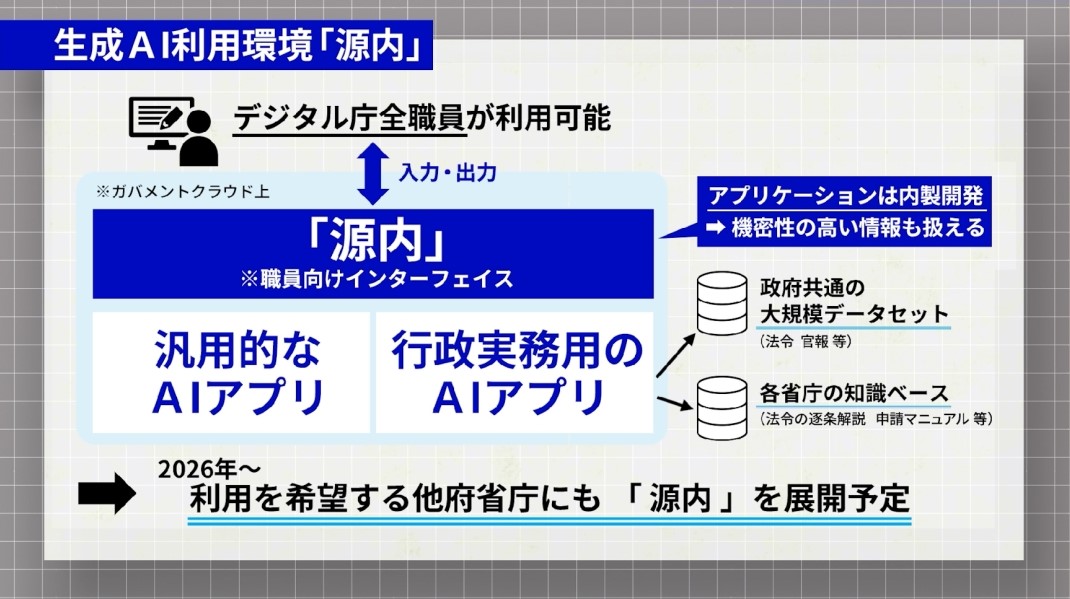
(Source: Government Employees into AI Engineers!? Government AI in Shaping the Future of Public Administration (GENAI Explanation))(Digital Agency News YouTube)
Applications Provided by "GENAI"
Under security that complies with the government unified standards, "GENAI" supports prompt input including Confidentiality Level 2 information within the Digital Agency. It supports Single Sign-On (SSO) from a portal site utilizing Government Solution Services (GSS), achieving both security and convenience.
The AI apps provided by “GENAI” are broadly classified into two types:
- General type AI: A set of tools that broadly support daily operations, such as interactive chat, document drafting, summarization, proofreading, and translation.
- AI for Administrative Operations: A set of applications specialized for administrative practices that support the execution of duties by government officials.
For a list of AI applications currently used within the Digital Agency, please refer to the List of AI Applications Provided within GENAI (as of February 20, 2026) (PDF / 145KB).(Japanese text)
Strategic Measures and Initiatives
Digital Agency is promoting the following five initiatives related to Government AI “GENAI.”
(1) Development and Deployment of the Generative AI Environment "GENAI"
To enable creative use of AI in administrative operations and demonstrate the value of trustworthy AI to the public, a large-scale pilot project will be conducted in fiscal year 2026, involving approximately 180,000 government employees across all ministries and agencies using generative AI.
In this pilot project, we will proactively create opportunities for officials to gain practical experience and evaluate the effectiveness and challenges of generative AI in administrative operations, with a view to full-scale implementation from fiscal year 2027 onward. Additionally, we will develop a dashboard to visualize the usage status of generative AI in ministries and agencies, enabling an overview of AI utilization across the entire government.
Digital Agency has conducted generative AI workshops for central government employees since fiscal year 2023, accumulating technical verifications and hearings at administrative sites. Through these, it became clear that even the trial use of generative AI at administrative sites requires many adjustments and procedures, and that verifying effectiveness in actual operations is difficult in environments where confidential information cannot be handled. Based on these insights, the generative AI environment "GENAI" was developed step-by-step by reflecting field challenges into development while meeting security requirements based on government-wide standards through in-house development.
While high-performance LLMs are evolving rapidly, the know-how regarding "which data to utilize, in what order, and from which perspective" for administrative operations and challenges unique to administration has not been systematically organized in a form that is easy for AI to utilize. Making practical data accessible to AI is a prerequisite for implementing AI in government. GENAI aims to be a mechanism for collecting, sharing, and circulating such know-how and frameworks in an open and structured manner.
To rapidly deliver the benefits of generative AI to the administrative domain, cross-organizational sharing of successful cases is indispensable. However, there are four barriers to adopting cases from other organizations into one's own: "unawareness of existing cases," "uncertain effectiveness," "unknown introduction methods," and "high costs." GENAI aims to systematically remove these barriers through the development of common rules and the publication and open sourcing of documentation.
(The image explains a shift from basic AI utilization to designing operations and data with AI as a prerequisite.)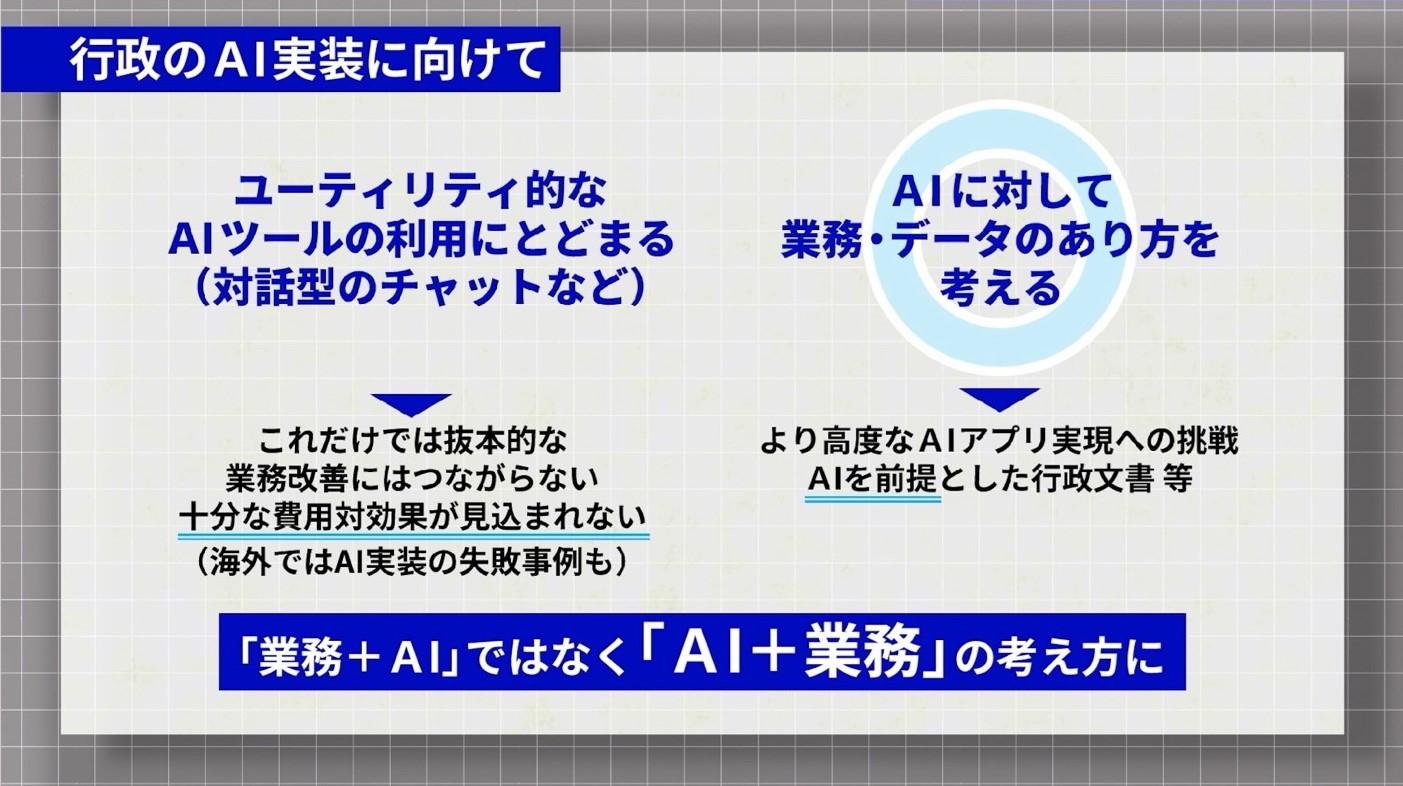
(Source: Government Employees into AI Engineers!? Government AI in Shaping the Future of Public Administration (GENAI Explanation))(Digital Agency News YouTube)
(2) Development of Advanced AI Applications
Digital Agency is developing prototypes to support administrative operations and share and deploy selected results across the government. As an example, we are developing the following applications:
AI for Supporting the Drafting of Diet Responses
- This application provides integrated AI functions such as analyzing the content of parliamentary questions, searching for past responses and supporting documents, generating draft responses, predicting follow-up questions, and verifying contradictions. By streamlining the response preparation process, it enhances the accuracy and consistency of government responses in the Diet.
Collaboration with the Employment Environment and Equal Opportunities Bureau, Ministry of Health, Labour and Welfare
- Develop generative AI applications targeting three areas of operation: “Processing notifications for general employer action plans,” “Certification review for Eruboshi and Kurumin programs(*),” and “Handling comprehensive labor consultations under the Individual Labor Dispute Resolution System.” These efforts will contribute to the smooth and effective implementation of administrative operations in employment environment and equal opportunity policy.
- (*)Note: Eruboshi and Kurumin are the official certifications granted by the Ministry of Health, Labour and Welfare (MHLW) to recognize companies with excellent social initiatives. They appear in the section regarding collaboration with the Employment Environment and Equal Opportunities Bureau.
- Develop generative AI applications targeting three areas of operation: “Processing notifications for general employer action plans,” “Certification review for Eruboshi and Kurumin programs(*),” and “Handling comprehensive labor consultations under the Individual Labor Dispute Resolution System.” These efforts will contribute to the smooth and effective implementation of administrative operations in employment environment and equal opportunity policy.
AI Support for Administrative Back-Office Operations
- Develop prototype systems utilizing generative AI to address tasks that place a significant burden on staff, such as committee management and business trip coordination, and verify their effectiveness.
(3) AI Support for the Development of Domestic Large Language Models (LLMs)
For Government AI, LLMs that adapt to Japanese vocabulary and expressions and respect Japanese culture and values are indispensable. Through the procurement and utilization of AI developed domestically, we will promote safe and secure AI utilization, improve performance, and create stable demand, thereby advancing realization of Japan’s AI autonomy.
(4) Development of Large-scale Datasets common within the government
With Government AI, we will develop large-scale common datasets shared across the government and related organizations.
(5) Technical Support for Other Ministries and Agencies
Digital Agency is actively supporting AI utilization by other ministries and agencies. Efforts to date include:
AI-based classification of large volumes of public comments and opinions (from June 2025), the contracted development of AI systems capable of analyzing administrative documents held by ministries and agencies (from February 2026), and the filtering of X posts that may correspond to recruitment information for criminal activities (National Police Agency, from December 2024).
(The image shows a case study of how AI reduced 2 months of government operations to just 3 days.)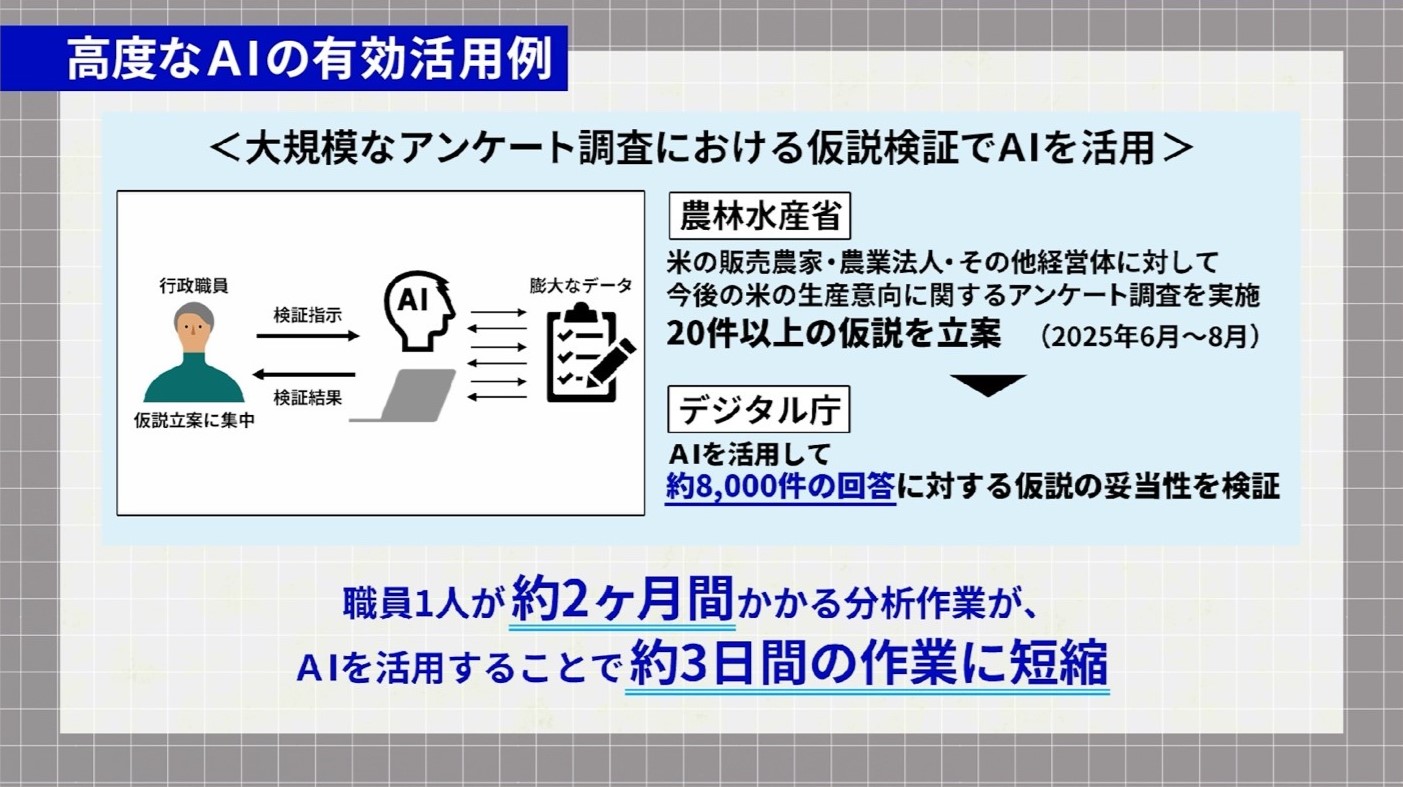
(Source: Government Employees into AI Engineers!? Government AI in Shaping the Future of Public Administration (GENAI Explanation))(Digital Agency News YouTube)
“GENAI” Rollout Schedule
The rollout schedule for GENAI is as follows
- From May 2025: Operations launched for Digital Agency employees.
- December 2025: Public call for domestic large language models (LLMs) to be trialed under Government AI.
- From January 2026: Trial use at selected ministries and agencies (Release 1.0). Scale: Several hundred personnel in total.
- February 2026: Rollout of a RAG application for administrative documents; user briefing sessions for GENAI for ministries and agencies participating in Release 1.0.
- From around May 2026 to the end of the fiscal year: Large-scale implementation pilot for the proactive ministries and agencies (Release 2.0).
- GENAI will be provided to government employees to evaluate its effectiveness and identify challenges in the use of generative AI in administrative operations.
- Spring to Summer 2026: Ministries and agencies planning to adopt GENAI will submit budget requests (for FY2027 onward) in preparation for full-scale deployment.
- Around Summer 2026: Trial introduction of domestic LLMs developed by Japanese companies and other entities (Release 2.1).
- Around December 2026: Trial provision of advanced generative AI applications (Release 2.2); development and provision of government-wide common datasets for generative AI (Release 2.2).
- From the fiscal year 2027: Full-scale utilization of generative AI (with budgetary measures implemented by participating ministries and agencies) (Release 3.0)
Reference Materials
- Government AI Initiatives (PDF / 7,008KB)(Japanese text)
- ”Government AI GENAI” Trademark and Brand Guidelines(PDF / 679KB)(Japanese text)
Councils and Committees
Related Information
- Basic Plan for Artificial Intelligence(Cabinet Office)(Japanese site)
- Act on the Promotion of Research and Development, and Utilization of AI-Related Technology (AI Act)(Cabinet Office)
- Priority Plan for the Realization of a Digital Society
- Basic Policy on Economic and Fiscal Management and Reform(Cabinet Office)(Japanese site)
- Headquarters for the Realization of a New Form of Capitalism / Council for the Realization of a New Form of Capitalism(Cabinet Secretariat)(Japanese site)
- Headquarters for Japan's Growth Strategy / Council for Japan's Growth Strategy(Cabinet Secretariat)(Japanese site)
- Comprehensive Economic Measures for the Realization of a "Strong Economy"(Prime Minister's Office)(Japanese site)