
Dashboard on the co-processing of municipal affairs
- Last Updated:
We are conducting a survey to improve and enhance this dashboard. Please use the form below to give us your opinions.
Table of Contents
- System for joint processing of business
- Co-processing by type of clerical work
- Joint disposal by disposal method
- Important Points
- Contact Information
1. System for jointly processing clerical work
As one of the means for local governments to provide sustainable administrative services amid a declining population, it is promoting wide-area cooperation (collective processing of clerical work) among local governments.
On the dashboard, approximately 50,000 items of clerical work can be organized into 8 major classifications, 32 minor classifications, and 179 minor classifications, and the status of joint processing of clerical work among local governments can be confirmed by clerical work classification and processing method.
For detailed explanations of the joint-processing systems for clerical work and the classification of clerical work, please visit Diversified Wide-area Cooperation (Ministry of Internal Affairs and Communications) .
2. Status of joint processing by clerical work category
2.1. Tabulated Summary
The figure shows the number of cases in which local governments are jointly processing clerical work (hereinafter referred to as the "number of clerical works"), divided into eight major categories and middle categories. It is possible to check the categories and the number of clerical works jointly processed by prefectures nationwide or by prefecture.
For a detailed explanation of each item, please visit Defining Data: A Dashboard for Co-Processing Municipal Affairs.
2.2 National Comparison
You can select the classification of office work, and confirm and compare the number of office works per prefecture and per municipality by switching.
Since the number of municipalities differs from prefecture to prefecture, the number of administrative works tends to increase as the number of municipalities increases. Therefore, on this dashboard, it is also possible to confirm the "number of administrative works per municipality," which is the number of administrative works divided by the number of municipalities.
2.3 Comparison with Other Organizations
You can compare your organization with other organizations based on the number of administrative processes and the number of administrative processes per municipality. By displaying two regions side by side, you can see the trends and differences between the regions.
3. Status of joint disposal by disposal method
The Local Autonomy Law provides seven systems for joint disposal as mechanisms for local governments to cooperate over a wide area.
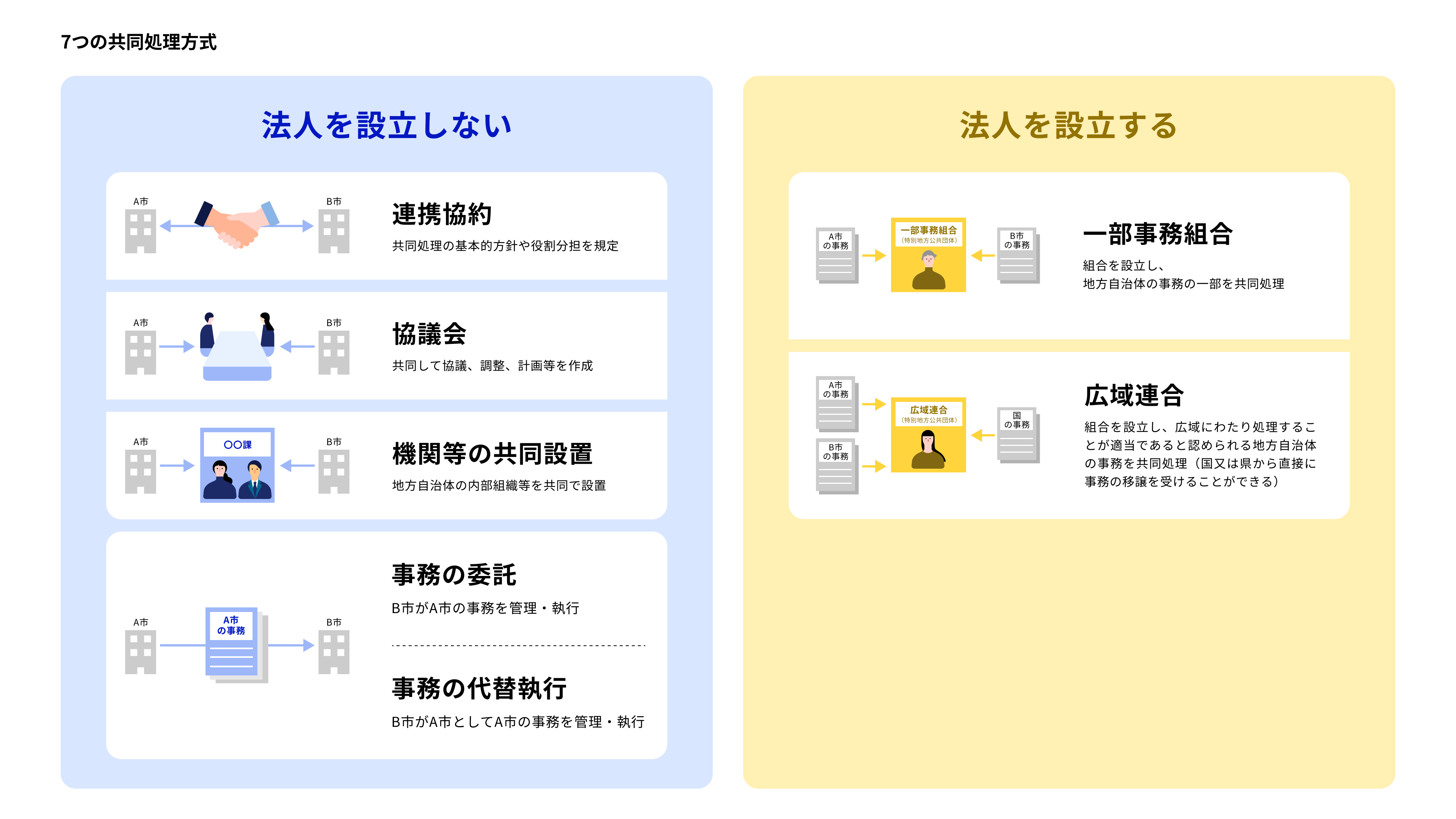
3.1 Breakdown of Processing Methods
By selecting a clerical work classification, the breakdown of processing methods for each prefecture can be confirmed and compared in terms of the number of clerical works and ratios, as well as graphs.
You can also select a state or province and see a map that breaks down the geographic treatment scheme.
3.2 Prefecture Maps
By selecting a category of clerical work, it is possible to check the joint processing status of clerical work by prefecture in a list and map format. Items that can be checked are the entity responsible for clerical work, the processing method, the number of municipalities covered by that entity, the outline of clerical work, and the constituent organizations.
If you select the responsible organization for office work from the list, the map, the outline of office work, and the constituent organization will be switched.
3.3 List of Administrative Works
In the list of office work, you can check information such as office work classification, processing method, start time, supplement and support of prefectural governments, etc. By narrowing down the information you want to check, you can search for examples of joint processing of office work. It is also possible to narrow down from a free word across items in the table.
4. Important Points
Data.
- The various date used for the dashboard was collected in Ministry of Internal Affairs and Communications with the cooperation of each prefecture based on the "Report on the Status of Joint Administrative Processing by Local Governments."
- The map on the dashboard is based on Digital Land Information (Administrative Boundaries) (Ministry of Land, Infrastructure, Transport and Tourism) .
- Due to the convenience of the system, the map mechanically displays islands of a certain area or larger.
- All of this data is pulled together and published into a structured dashboard.
- Datatable (ZIP/2,636 kb) (updated 8 / 26 / 2026)
Data Definitions
For the definition of data, refer to the following.
Refresh Data
The various numbers in the dashboard will be updated quarterly.
True or false information
For more information on true or false data on this dashboard, please see True or False: A dashboard on the co-processing of municipal affairs .
5. Contact Information
City, Town and Village Affairs Division, Local Ministry of Internal Affairs and Communications
- TEL: 03 5253 5516
- Email: shichousonka01 _ atmark _ soumu. go. jp
- To prevent spam mail, "@" is displayed as "
_ atmark _". When you send mail, please replace "_ atmark _" with "@" (one byte).
- To prevent spam mail, "@" is displayed as "