
[Explanation of Government AI GENAI App] Investigation and analysis of parliamentary answers
AI App to Support Parliamentary Questioning
When creating a draft answer to a question in the Diet, I think there are many cases where past questions and answers are referred to. However, keyword searches require changing and rearranging words to search, so it is difficult to get to the information you want.
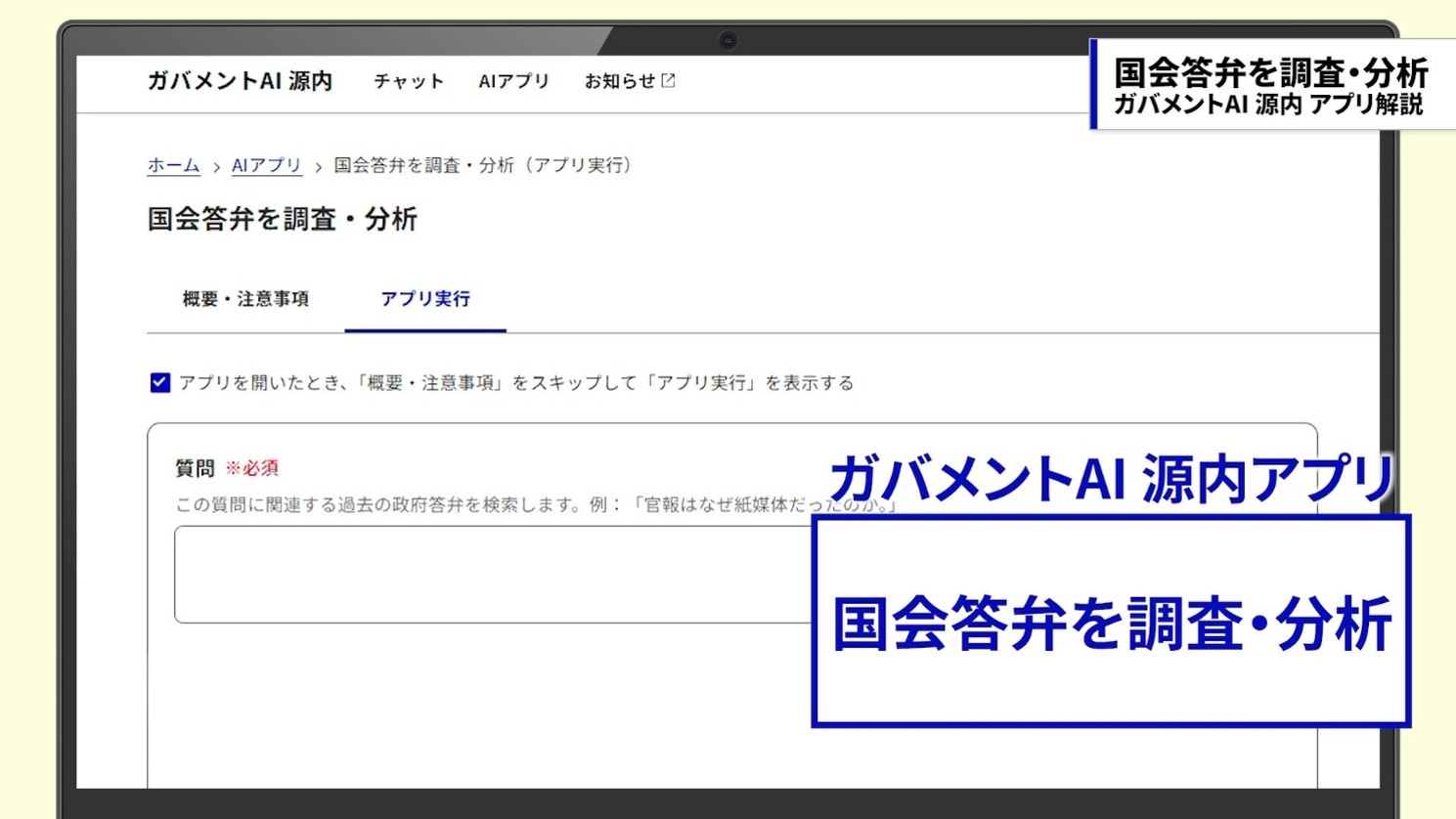
Government AI GENAI's "Investigate and analyze parliamentary answers" app can be used in such cases. Just by entering a simple question, you can narrow down answers that are highly relevant.
This time, a Ken Yasuda in the lower laws and regulations group of the Digital Agency Digital Law will explain how to overcome the challenges in dealing with the National Assembly in "Government AI GENAI" along the screens. 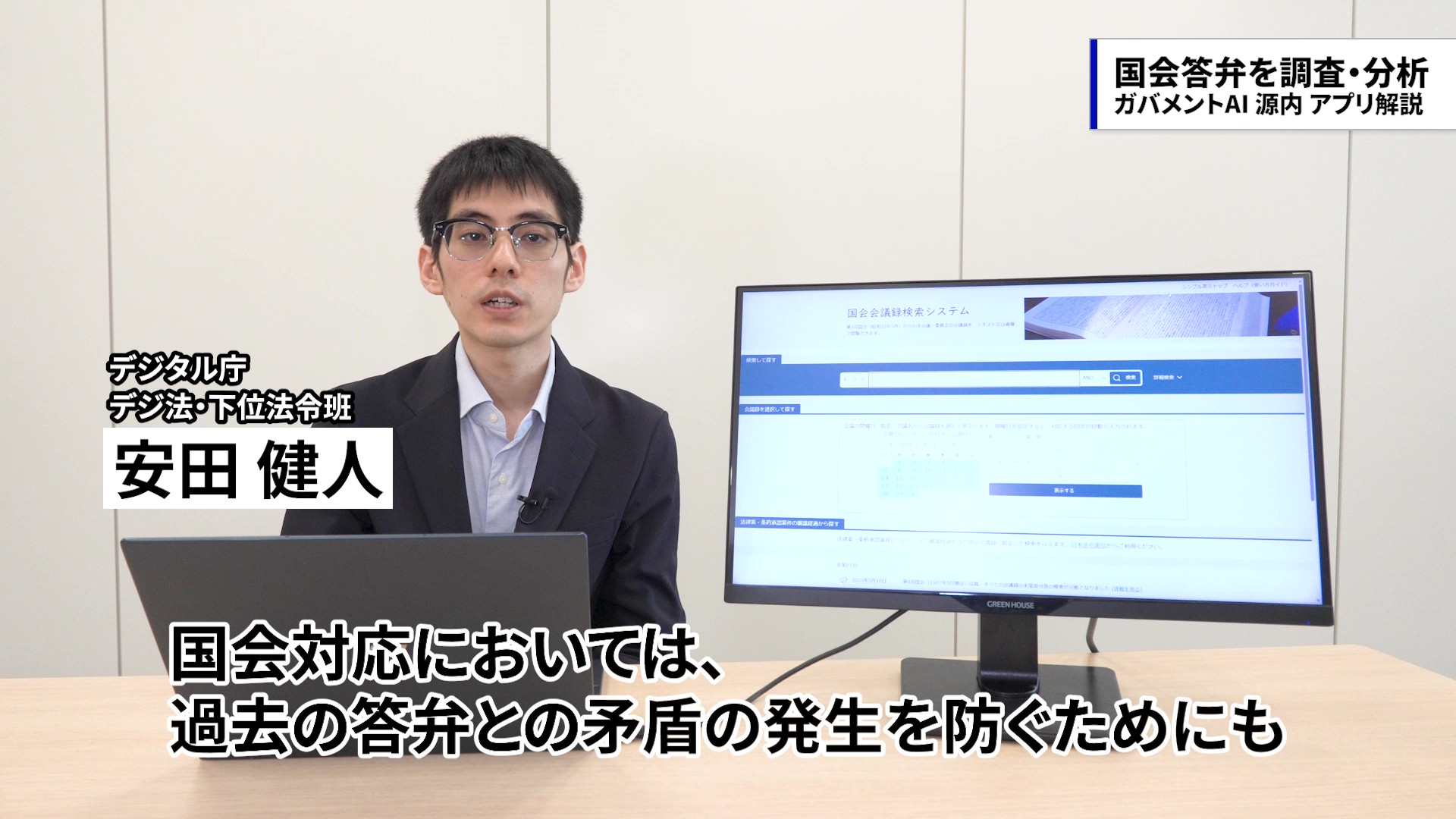
The following is Yasuda's explanation.
Search Questions and Answers with Natural Language
In dealing with the Diet, in order to prevent the occurrence of inconsistencies with past answers, it is necessary to examine past minutes of meetings.
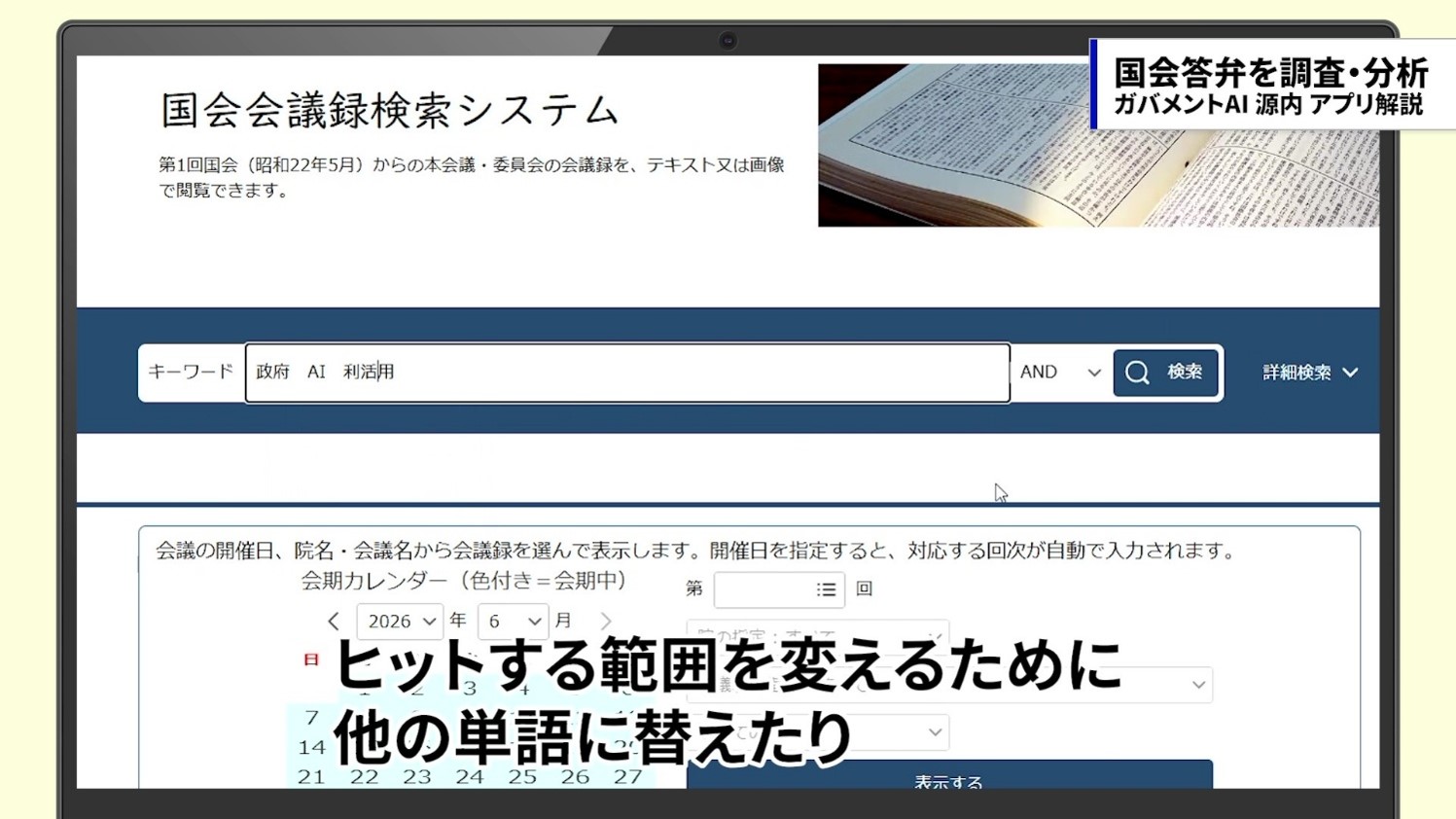
However, when we try to search for answers to a question about "AI use and application by governments," for example, we have to enter a keyword and add a word if the keyword is too broad, or replace it with another word to change the search range.
Finding the information you need in a limited amount of time can be difficult.
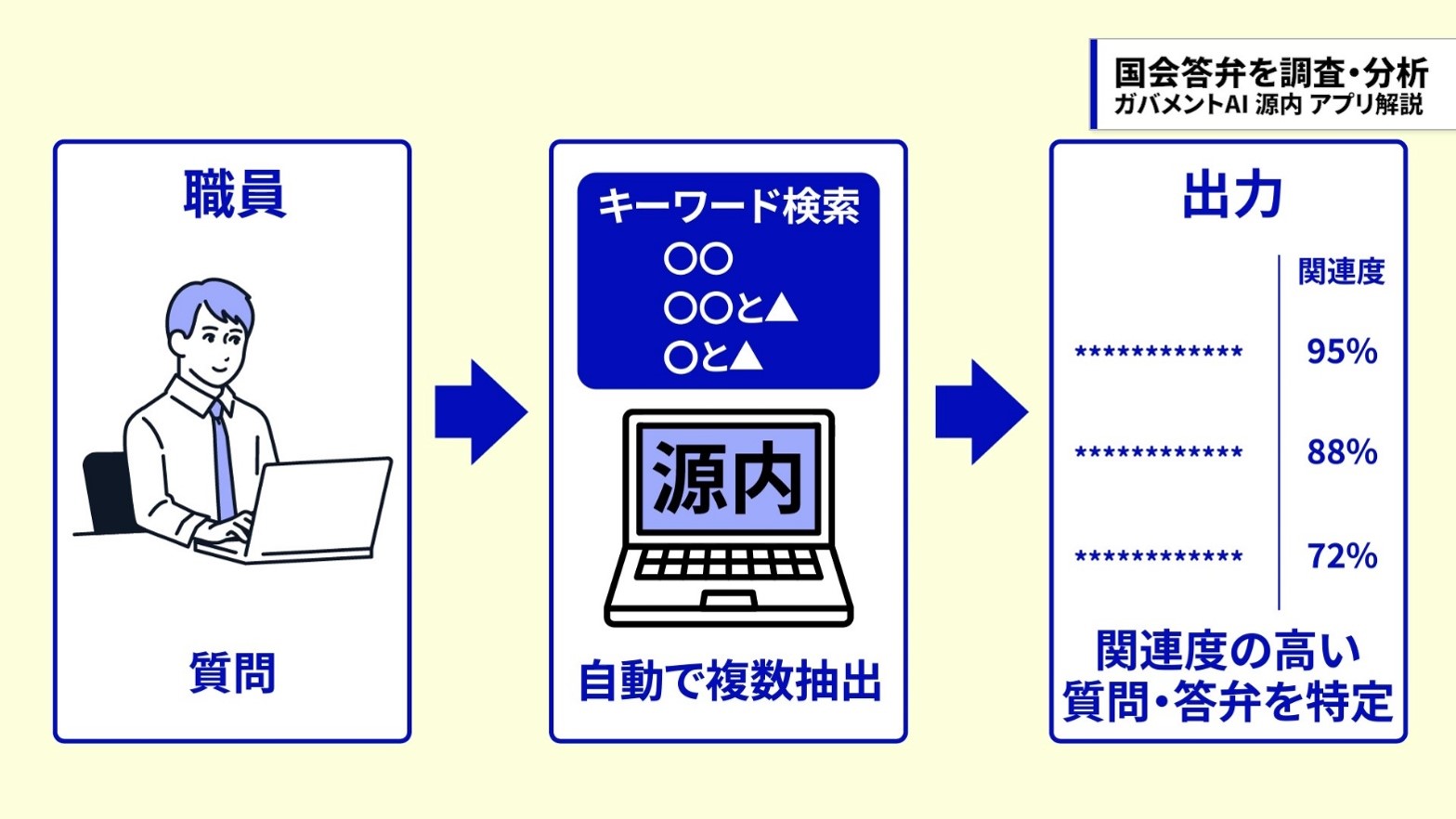
This is where the "Investigate and Analyze Parliamentary Answers" app from Government AI GENAI can help. If you type in natural language what you want to look up, it will be easier to find the relevant question or answer.
In the app, the AI automatically extracts multiple keywords based on the input natural question. Furthermore, by searching for parliamentary proceedings in various combinations, highly relevant questions and answers are identified.
Extracting Relevant Answers from National Assembly Minutes
For example, when you need to make a draft answer about the My Number Card of the baby.
Enter into the question field, "Do you need a headshot for your baby's My Number Card?"
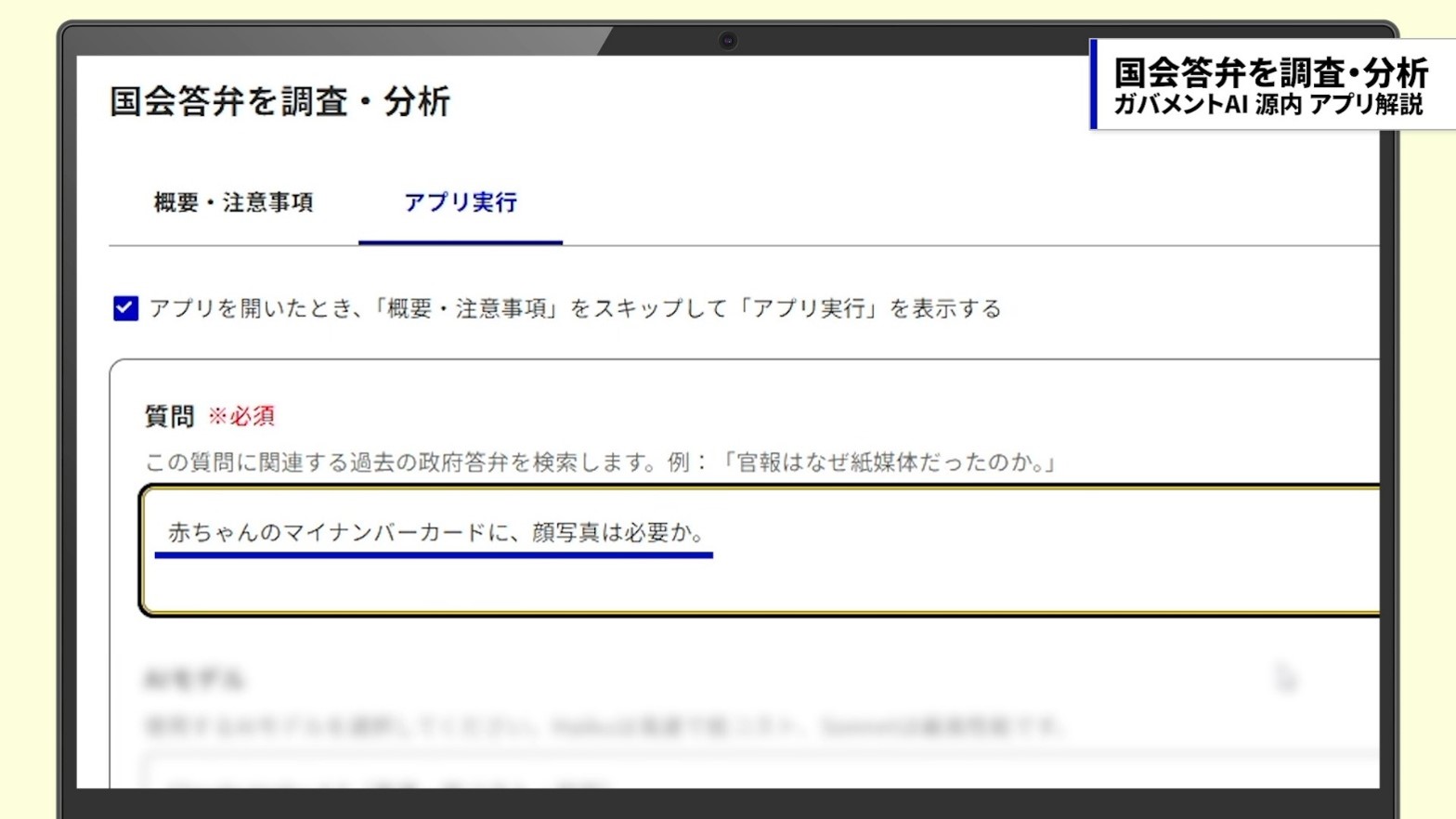
When executed, it outputs questions and answers in order of relevance, such as "90%" relevance from past Diet meeting minutes, and summarizes the main points.
In this example, the conclusion is as follows: "In the My Number Card for babies, only infants under one year old do not need a photo of their faces."
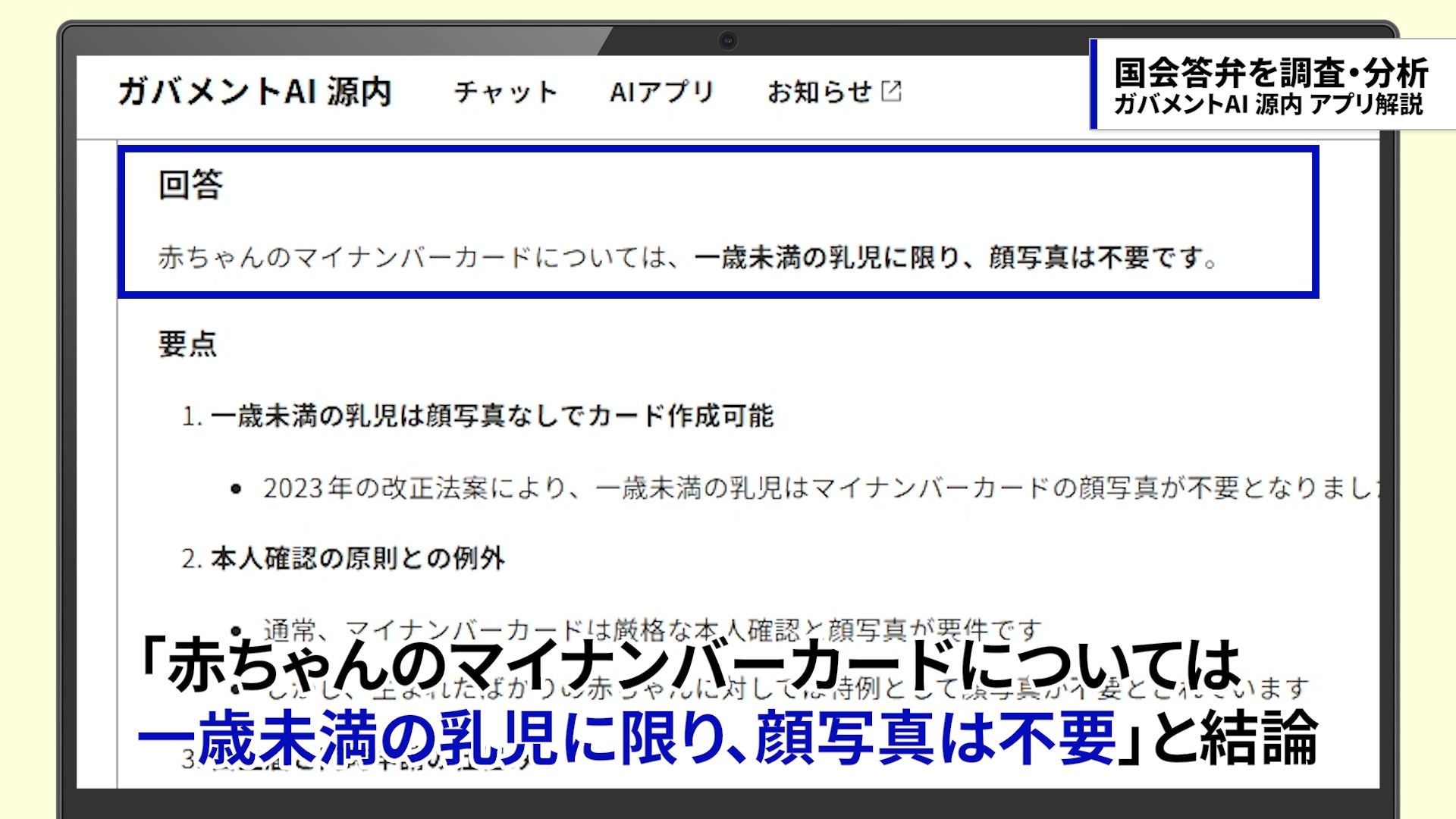
If you look at the keywords that were output before this happened, you can see that the AI was able to replace the word "baby" in the question with other expressions such as "baby" or "under 1 year old."
In addition to saving you the trouble of entering keywords each time, you can also extract keywords that you may not have thought of yourself.
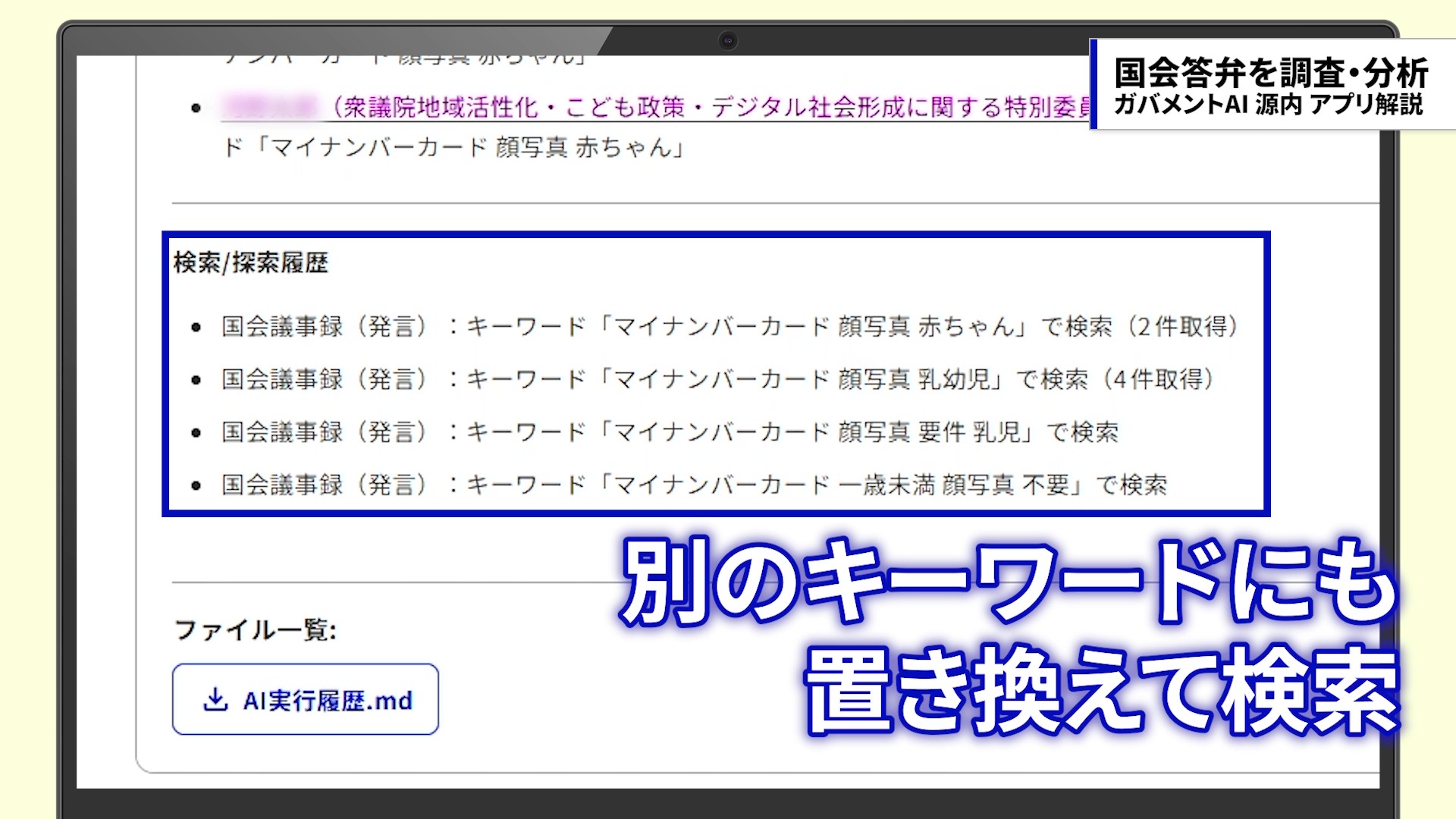
This allows you to find relevant information even with vague instructions, reducing the risk of omission.
Utilization expanding beyond the drafting of answers
Thus, the app was originally developed based on the voice of an employee who wanted to "streamline the preparation of draft answers."
On the other hand, some people say that it can be used when they want to organize policy issues in a cross-sectoral manner when planning policies.
Sorting out policy issues in a cross-sectoral manner
For example, topics such as "public officer Systems" cover a wide range of policies and competent ministries and agencies, such as "Personnel Systems," "Measures to Secure Human Resources," and "Digital Transformation of Administration."
As a result, it is not easy to grasp the overall picture of the challenges simply through individual committee discussions.
So I ask the AI app, "What is the most recent major issue in public officer's institutional reform?"
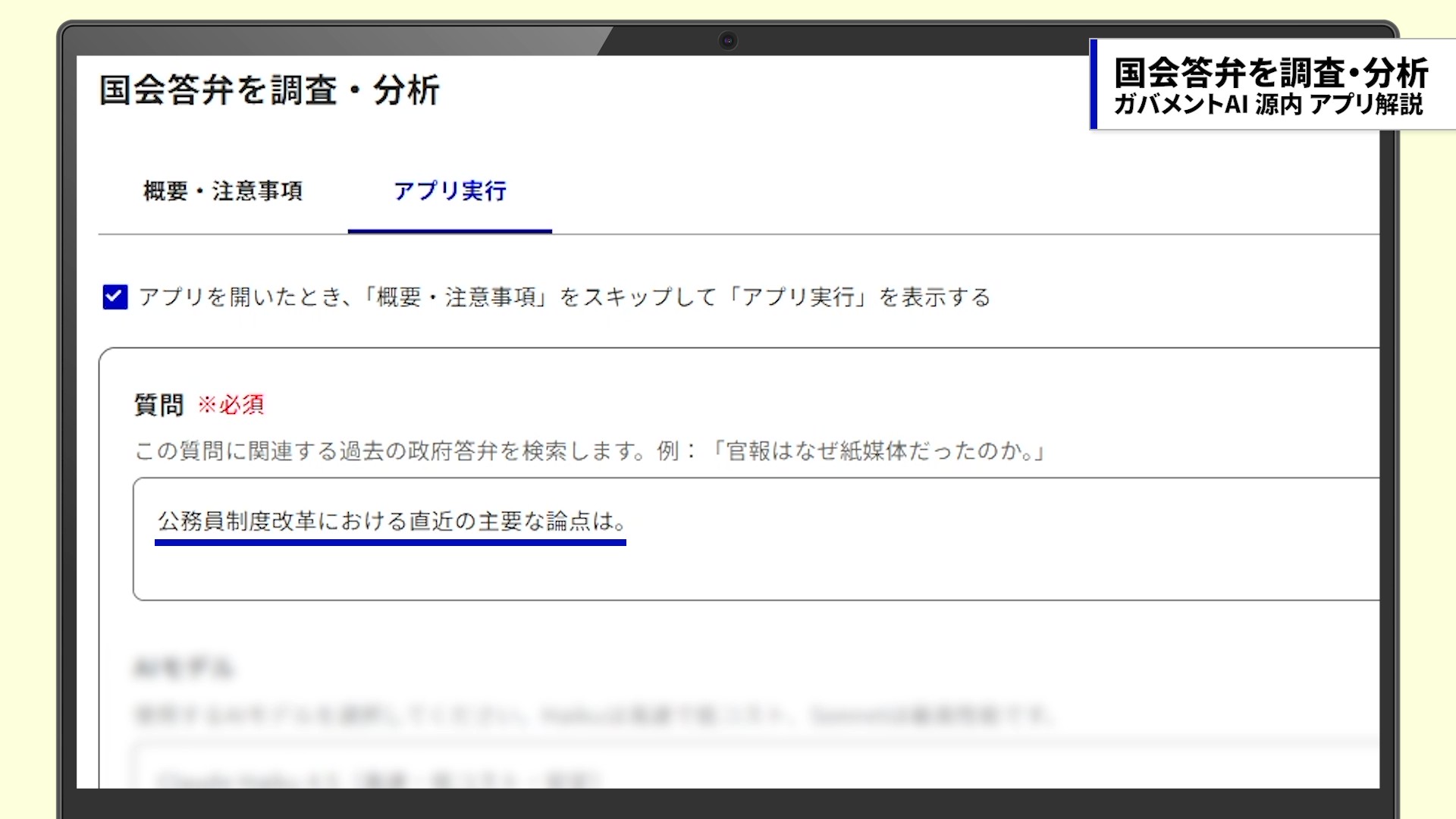
When executed, the AI extracts keywords such as "public officer salary" and "personnel evaluation" from the input content, and searches for highly relevant questions and answers.
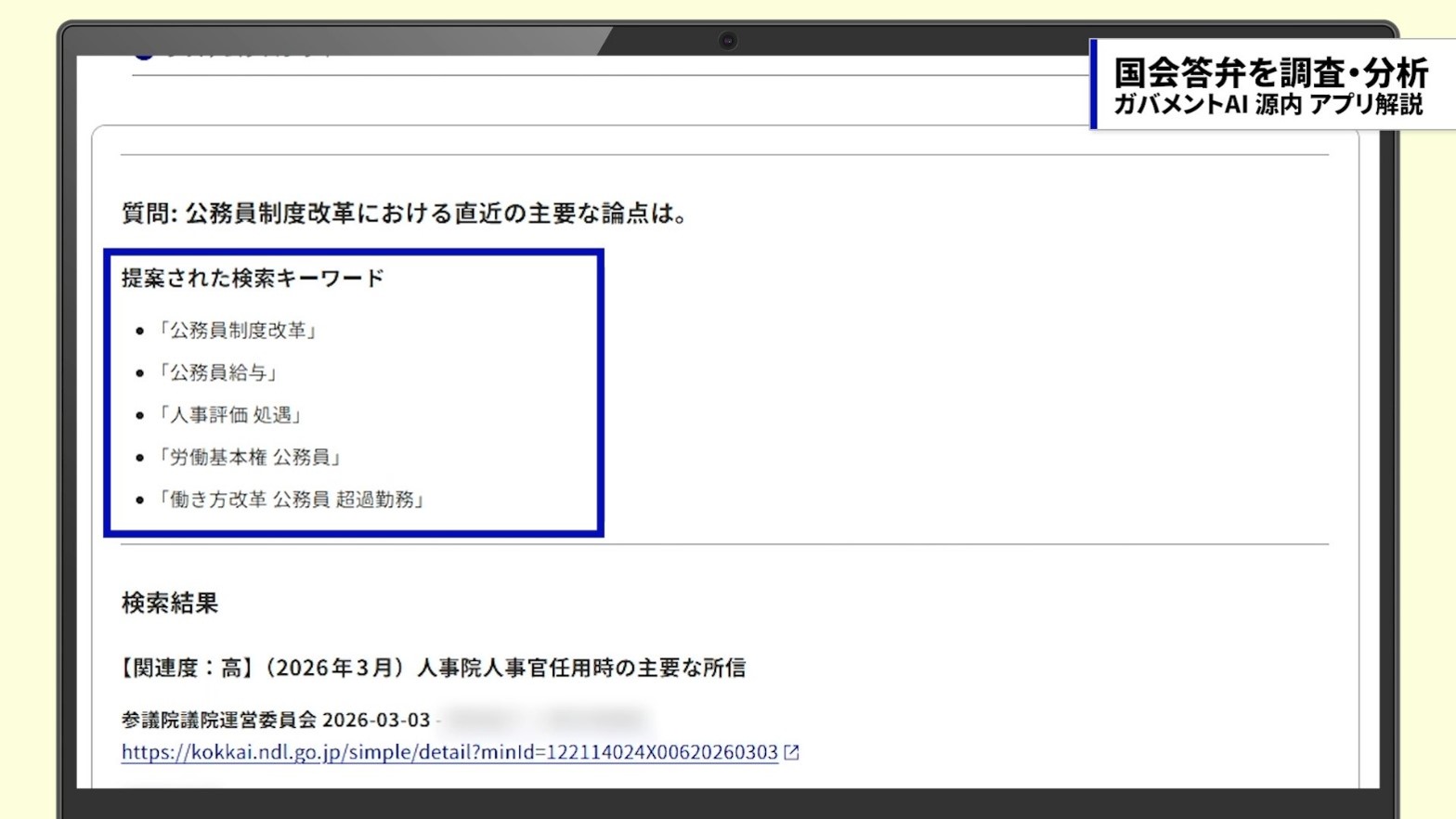
Furthermore, based on those contents, we will summarize major questions and answers that have been held at the National Assembly so far.
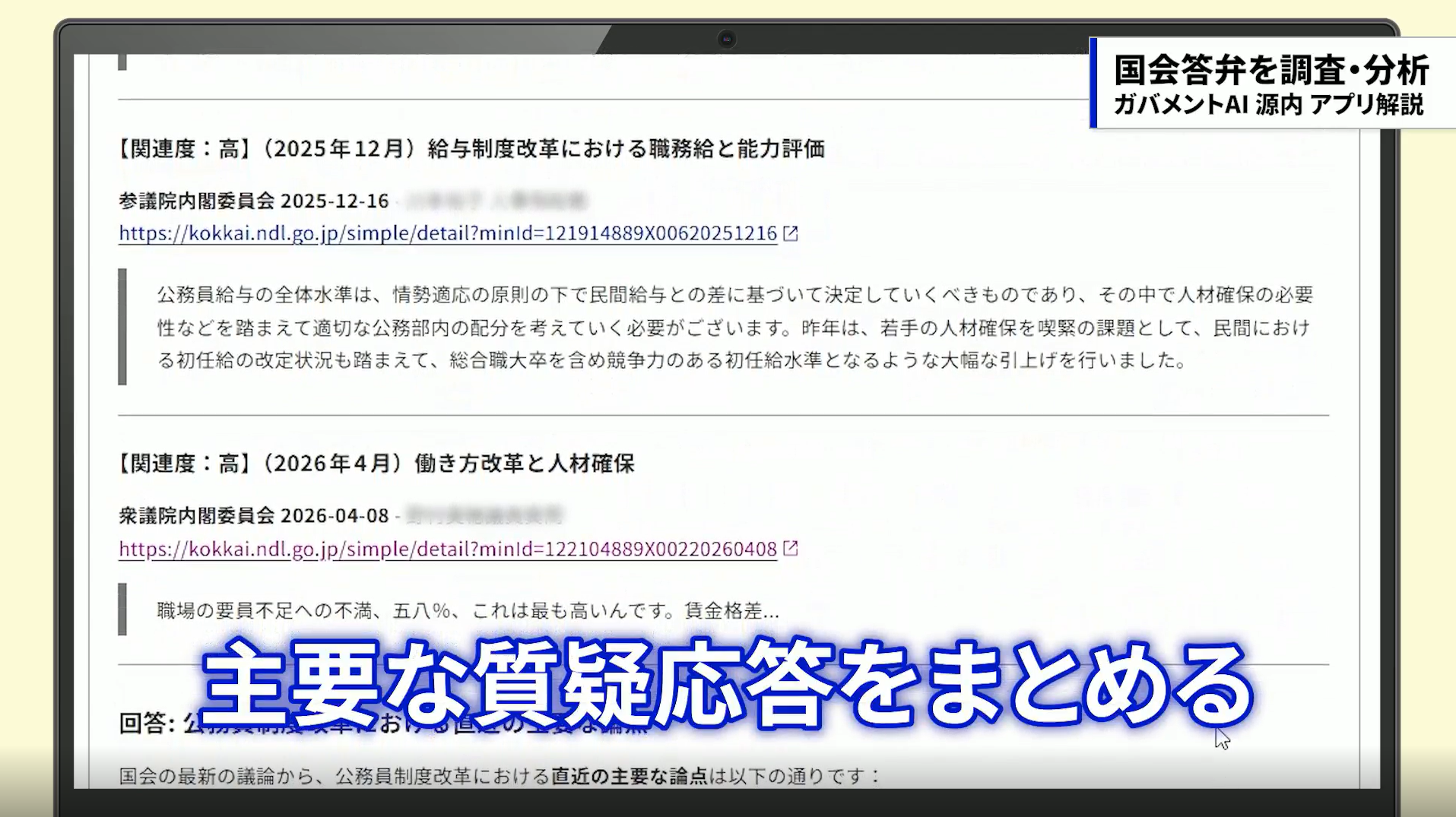
In this example, as shown below, "securing human resources and reforming the salary system" and "reforming working styles and correcting long working hours" are among the main issues raised.
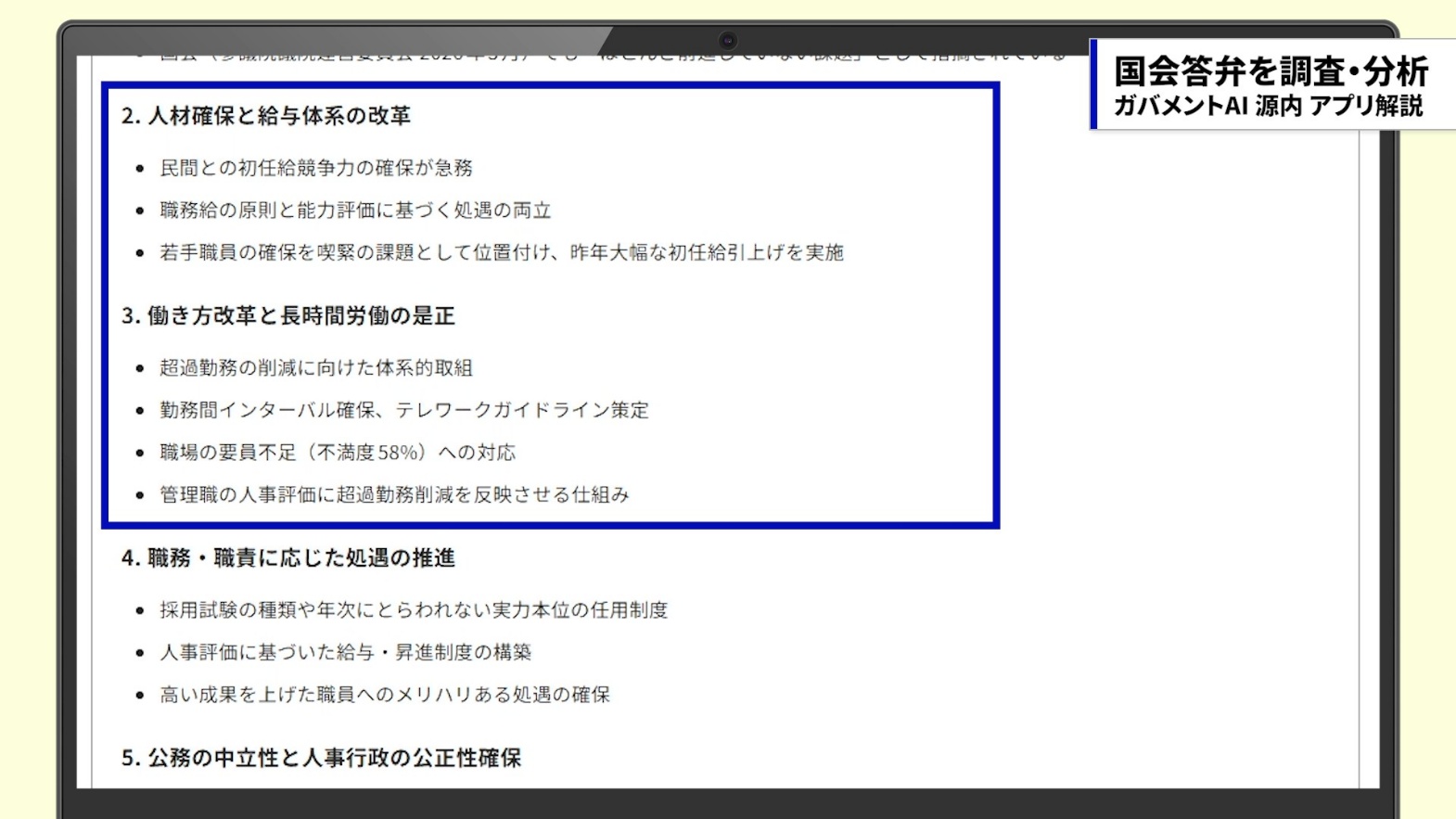
Discussions can be examined in a cross-sectoral manner, so issues can be viewed from multiple perspectives and utilized in policy decisions, etc.
Reducing research time and engaging in substantive discussions
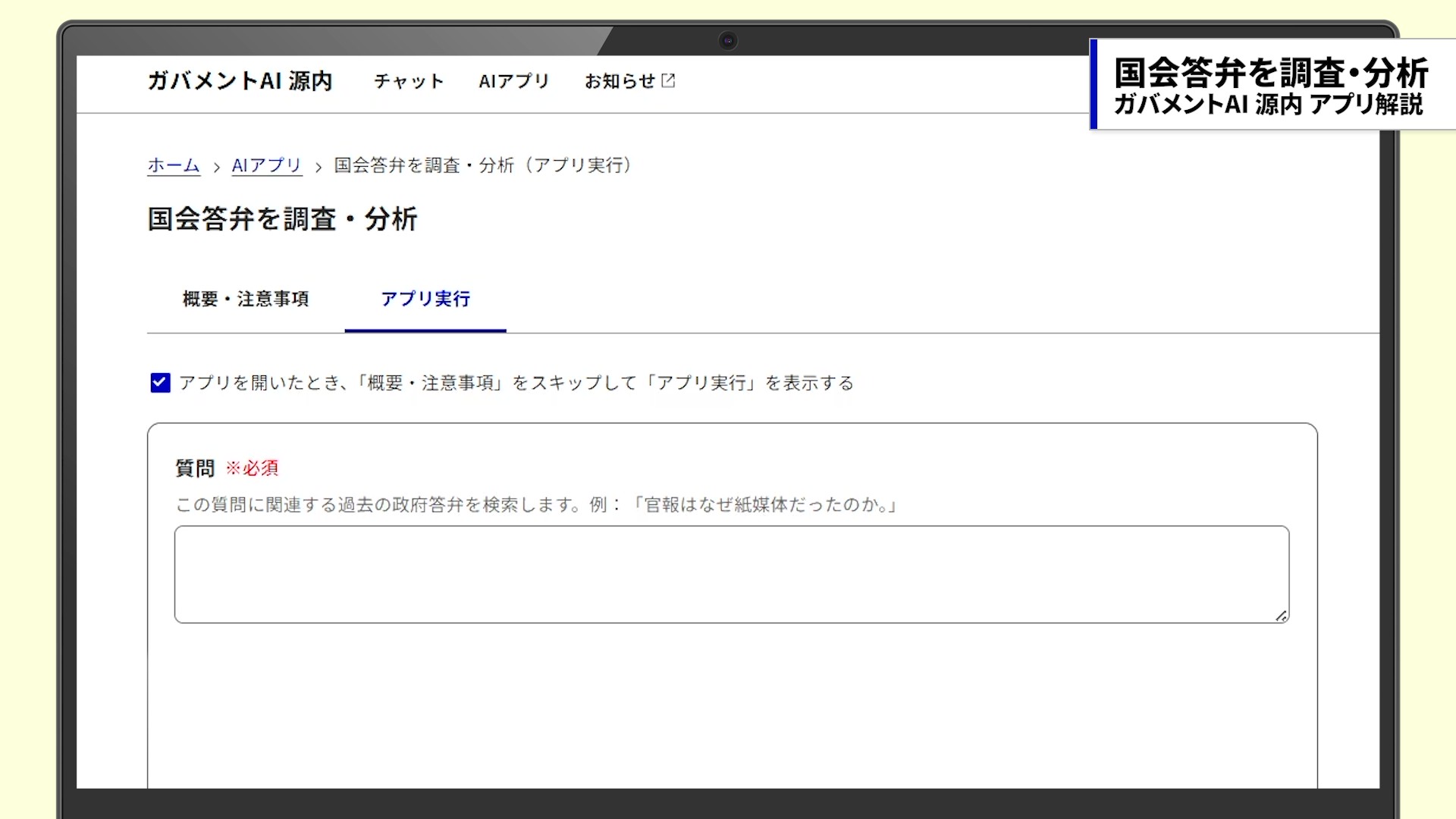
When you want to look up past questions and answers in the Diet, this app greatly reduces the time spent on research. As a result, you can focus on discussing the essentials of policy.
Once you try the app, you shouldn't be able to go back to your usual search system. Please try it once.