This page has been translated using TexTra by NICT. Please note that the translation may not be completely accurate.If you find any mistranslations, we appreciate your feedback on the "Request form for improving the automatic translation ".

Area Data Coordination Platform

By linking and sharing information such as administrative procedures, health, transportation, disaster prevention, and tourism between various services that support people's lives, we will provide services optimized for individual needs and promote digitalization in local communities. By utilizing information through area Data Coordination Platform, we aim to promote digital transformation in local communities and realize a society where diverse happiness can be realized.

Notice

Table of Contents

  1. Background:
  2. About Area Data Coordination Platform
  3. Actual Introduction of Area Data Coordination Platform
  4. that makes the most of
  5. Contact:
  6. Related Information

1. Background

Currently, many regions in Japan are facing a phase of population decline, and the maintenance of services for residents is a challenge. Under these circumstances, in order to realize "services optimized for individuals," in which the supply side meets the circumstances of the demand side, and to improve the satisfaction of residents and revitalize local communities with limited resources, it is necessary to consider community development based on the three axes of "protecting local life," "creating a better life," and "gaining the ability to earn money in local communities."
In order to make these efforts a reality, it is essential to cooperate not only with the government but also with a variety of stakeholders, including private companies, NPOs and local residents.
In addition, in order to improve the added value of existing services and create new services for private companies and local governments, it is essential to utilize area data such as geographic data and public data, as well as data on various services that support daily life, such as administrative procedures, health, transportation, disaster prevention, and tourism.

All of these efforts are supported by digital technology and data utilization, and the Area Data Coordination Platform plays an important part in this.

In addition, for the realization of a digital society and Smart City , please also check the initiative that makes the most of area Data Coordination Platform.

A block diagram showing the concept of community development. In the center is the large word "community development," above which is the explanation, "Collaborate with various stakeholders." At the top, three objectives, "Create a better life," "Protect local life," and "Gain earning power in the local community," are connected by an arrow. In the center is the explanation, "Increase resident satisfaction by making the most of limited resources at a time of population decline." At the bottom, stakeholders such as residents, companies, NPOs, and education and research periods are shown in circles. At the bottom, a silhouette of the city and a blue band show the foundation of "Digital and data utilization and area data infrastructure to support it."

2. About Data Coordination Platform

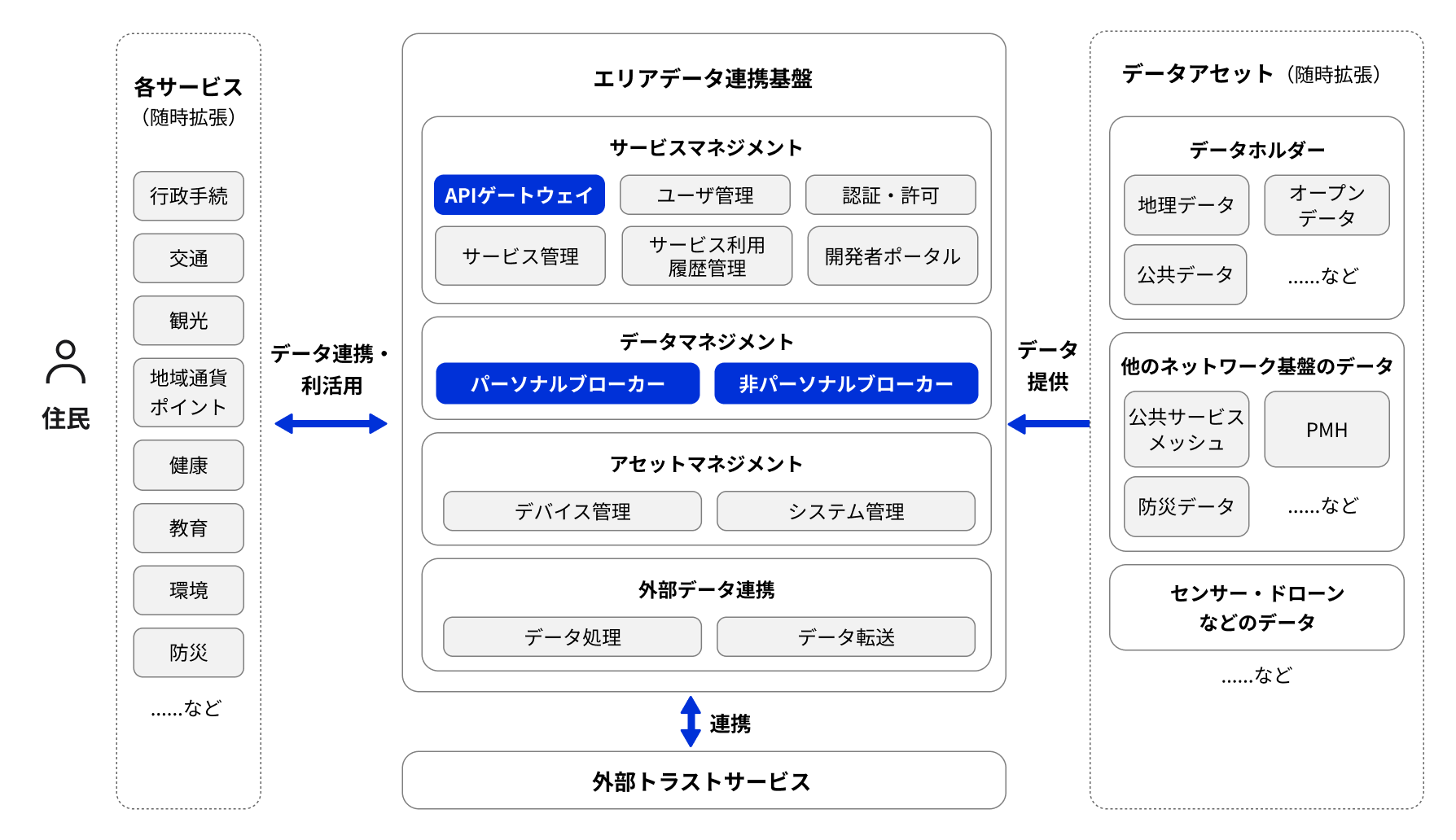
Area Data Coordination Platform is a system that aggregates local data and mediates them to various services such as administrative procedures and transportation.
As the core of a data-brokering function, we will utilize open data and other data-assets for various services. We will also promote efficient data-utilization by linking the data-held by each service. Therefore, we will demonstrate the true value of an area Data Coordination Platform by connecting many services and data-assets.

When building or introducing an area Data Coordination Platform, it is important to avoid overlapping investments in similar data-linked areas and to guarantee open specifications that are not tied to a specific service or service provider. This allows for the freedom of service design using an area Data Coordination Platform and the realization of services optimized for individuals. function

Based on this perspective, it is necessary to promote further utilization of area Data Coordination Platform while expanding their shared use in order to avoid unnecessary overlapping investment in infrastructure by local governments and to achieve sustainable operation.

A diagram showing the overall configuration of a data linkage system centered on an area Data Coordination Platform. On the left side are residents and various services (administrative procedures, transportation, tourism, local currency points, health, educational, environmental, disaster prevention, etc.), which are connected to the central area Data Coordination Platform as "data linkage and utilization" using two way arrows. The area Data Coordination Platform consists of four layers. The top layer is the service management layer, which includes API gateway (highlighted in blue), user management, authentication and authorization, service management, service usage history management, and developer portal. The second layer is the data management layer, which includes personal broker (highlighted in blue) and non-personal broker (highlighted in blue). The third layer is the asset management layer, which includes device management and system management. The lowest layer is the external data linkage layer, which includes the function for data processing and data transfer. At the bottom of the area Data Coordination Platform, two way arrows connect external trust services as "linkages." On the right side are data assets (which can be expanded from time to time), such as data holder (geodata, open data, public data, etc.), other network infrastructure data (public service mesh, PMH, disaster prevention data, etc.), and sensor / drone, which are connected to the central area Data Coordination Platform using an arrow "data provision."

Recommended Modules

In order to further promote these initiatives and promote interoperable data-sharing, we are providing a recommended module that will serve as the core of an area Data Coordination Platform.

For support for the introduction and use of recommended modules and updated information on recommended modules, please check Area / Data Coordination Platform Initiatives (Data Society Promotion Council) .

Introduction of content related to Area Data Coordination Platform by the Data Society Promotion Council (DSA)

3. Introduction of Area Data Coordination Platform

Status of Area Data Coordination Platform Utilization

Utilization status in Japan

Utilization by Local Government

Configuration of Area Data Coordination Platform

Area Data Coordination Platform Configuration (recommended module)

Area Data Coordination Platform Configuration (Usage IDs)

4. Measures to make the most of Data Coordination Platform

In order to realize a digital society and smart cities, we need the concept of "Architecture Area Architecture in Data Coordination Platform area Data Coordination Platform" and "Joint Use of Joint Use of Area Data Coordination Platform and Joint Vision" to use the infrastructure together to solve the same problem in a unified area.

Area Architecture in Data Coordination Platform

In order to promote smart cities and solve local issues, it is important to consider solutions across sectors and utilize a unified Architecture. The Smart City Reference Architecture published by Cabinet Office is a recommended blueprint that shows not only the system but also the overall framework and relationships including local governments and companies. By utilizing this reference Architecture, interoperability is ensured and smooth data utilization can be realized.

Joint Use of Area Data Coordination Platform and Joint Vision

In order to promote digital-based digital transformation in local areas, the use of data and the concept of data-driven (decision-making and problem-solving based on objective data) are essential elements.
In order to achieve this, it is necessary to utilize area Data Coordination Platform. Since considerable costs are required for operation and resources are also required for operation and maintenance, it is useful to promote joint use at the prefectural level, which has a certain regional spread, rather than introducing and operating on a single local government.

When promoting shared use, it is important to have sufficient discussions with the basic local governments in the region on how to utilize data and how to realize continuous operation, including costs, by jointly using the infrastructure, rather than being preoccupied with "building the infrastructure" or "using the infrastructure."

In addition, shared use has the following advantages

  • To reduce infrastructure and personnel costs
  • Promotion of DX in wide areas
  • Promoting shared use of services

This figure shows the three advantages of sharing an area Data Coordination Platform. The first, "cost reduction of infrastructure and human resources," is illustrated in the center of the frame to express the mutual burden of costs between City A and City B, and in the lower part of the frame, it is emphasized as "cost reduction per municipality due to the split effect." The second, "digital transformation promotion over a wide area," is illustrated in the center of the frame to express that information is spread over a wide area between City A and City B, and in the lower part of the frame, it is emphasized as "all citizens enjoy services equally regardless of their residence." The third, "promotion of shared use of services," is illustrated in the center of the frame to express that information between City A and City B is shared through infrastructure cooperation, and in the lower part of the frame, it is emphasized as "mutual shared use of services linked to infrastructure."

Area Data Coordination Platform Common Use Guidebook

We have published a guidebook that summarizes the issues and guidance necessary to promote the shared use of regional Data Coordination Platform and to realize services that are more optimized for individuals.

Area Data Coordination Platform datamap

When considering specific data utilization, it is necessary to first identify what kind of data is held, the current utilization method, and the potential utilization possibility.
In addition, by clarifying technical conditions such as connection methods and update frequency, it is effective to grasp usable data, correct duplication and inefficient linkage, and create a data map as a basic material for future data linkage design.
The benefits of creating a data map include:

  • Understanding the whole picture through visualization
  • Promotion of cross-sectoral cooperation
  • Improving efficiency of development and investment decisions
  • Strategic Prioritization

Data Map Authoring Format version 1.3 (Excel / 177 kb) (updated April 13, 2026)

Service Side Data Map

The information that the government and private companies have for each service can be provided and used by other services and businesses that need it through the area Data Coordination Platform.

A system configuration diagram showing a service side data map. At the top service layer, the three services of "Transportation / Mobility," "Medical / Health," and "Disaster prevention / crime prevention" are arranged from left to right in blue rounded rectangles, each of which contains a database icon. "Area Data Coordination Platform" is shown in the center as a horizontal frame. Data is provided to each service through the area Data Coordination Platform and used within the service. It shows how available data spreads to other services.

Data Asset Side Data Map

Open data, geographic data, and public data can be provided and utilized as data assets to other services and businesses that need them through the area Data Coordination Platform.

A system configuration diagram showing a data-asset side data-map. At the top service layer, three services, "Transportation and Mobility," "Medical and Health," and "Disaster Prevention and Crime Prevention," are arranged from left to right in blue boxes with database icons. In the middle, "Area Data Coordination Platform" is shown in a horizontal box. At the bottom data-asset layer, three database icons are arranged in a horizontal line. The connection relationship from each service to the lower database is shown by blue arrows via area Data Coordination Platform. A solid arrow extends from Transportation and Mobility, and a dotted arrow extends from Medical and Health and Disaster Prevention and Crime Prevention.

List of Visions for Shared Use (Summary of Contents of Each Prefecture)

The contents of the Vision for Shared Use formulated by each prefecture are classified, and the compiled data is shown below. A link is set for each prefecture name in the data. For details, please check the linked website.

5. Contact

Please contact us at the email address below for any comments or consultations regarding this matter.
Email: dd-rollout _ atmark _ digital. go. jp
*"@" is displayed as " _ atmark _ " to prevent spam mail. When you send mail, please change " _ atmark _ " to "@" (one byte).