
An Effort to Code Rules for Machine Readability in Administrative Data
- Last Updated:
"Rules for Machine-Readability in Administrative Data" was decided at the joint meeting of the 4th Interagency DX Promotion Liaison Conference and the 21st Meeting for the Promotion of a Digital Society Executive Committee Meeting held in on March 31, 2026.
Digital Agency is committed to developing Evidence-Based Policy Making (EBPM) and visualizing the effects of its policies. To this end, we aim to develop our own checking system and improve machine readability through AI tools and other means. To this end, we have provided data files (CSV and JSON formats) that enable accurate interpretation of the " Rules for Machine Readability (Cabinet Secretariat) (PDF format) ." These rules and files can be used not only by the government but also by private companies to improve the machine readability of data.
- Code for Rules on Machine Readability in Administrative Data (JSON format) (GitHub)
- Code for Rules on Machine Readability in Administrative Data (CSV format) (GitHub)
Table of Contents
- 1. Rules on Machine-Readability in Administrative Data
- 2. Encoding machine-readability rules
- 3. Download a list of rules and code
- 4. Use the Rule Compliance Check Tool
- 5. Inquiries
1. Rules on machine readability in administrative data
Background of Efforts
In the past, some AI published by local governments were printed on paper and formatted for human viewing (e.g., cell merging and blank line insertion). However, these formats are difficult for data analysis software and AI systems to handle.
In general, when using non-machine-readable information, it is necessary for the user to perform data cleansing. Appropriate cleansing on the part of the data provider will contribute to reducing transcription errors, visualization using BI tools, AI utilization, and cost reduction for society as a whole, including the promotion of EBPM. In particular, since the data cleansing released by the government has a large number of users (other government agencies, private sector, researchers, etc.), it is believed that the effect of reducing the burden of data will spread more widely throughout society than other data.
Three Levels of Data Quality
The " Rules on Machine-Readability of Administrative Data (Cabinet Secretariat) (PDF format) " establishes three levels of machine-readability so that officials from each ministry and agency can work on them in stages. Level 1 is positioned as "basic rules that are at least machine-readable", and Levels 2 and 3 show the technical path toward achieving higher levels of machine readability.
Specific rule examples
The specific rules for each level are as follows.
| Level 1: "Can view and post" | Level 2 "Available for aggregation and analysis" | Level 3 "Federation and automation possible" | |
|---|---|---|---|
| & Description | A machine-readable representation of human intended, in tabular form, separated by rows and columns, and containing text and numbers stored in a computer-readable form. | A statistical data format in which the rules are consistent from column to column and rows can be treated as samples and columns as variables. The data type (quantitative or qualitative) is clear, and missing values are handled uniformly. | A standardized coding system and metadata (units, definitions, history of updates, etc.) are in place and are comparable across time series or other statistical surveys. |
| Rule Example | "The file format should be Excel or CSV," "Do not put more than one table on a sheet," "Make sure that the data is not segmented," "Do not include information that is unrelated to the data itself," and "Make it one cell and one data." | "Assign numeric attributes to numeric data," "Do not omit item names, etc. in data," "Provide item names that can be uniquely identified in each column," and "Standardize multiple-choice answers." | "The code table for the responses is provided in the Appendix." "Enter the data unit." "Standardize the time axis." "Enter the data definition and update history." "Format the data vertically." |
2. Code machine-readability rules
Procedure for applying a rule
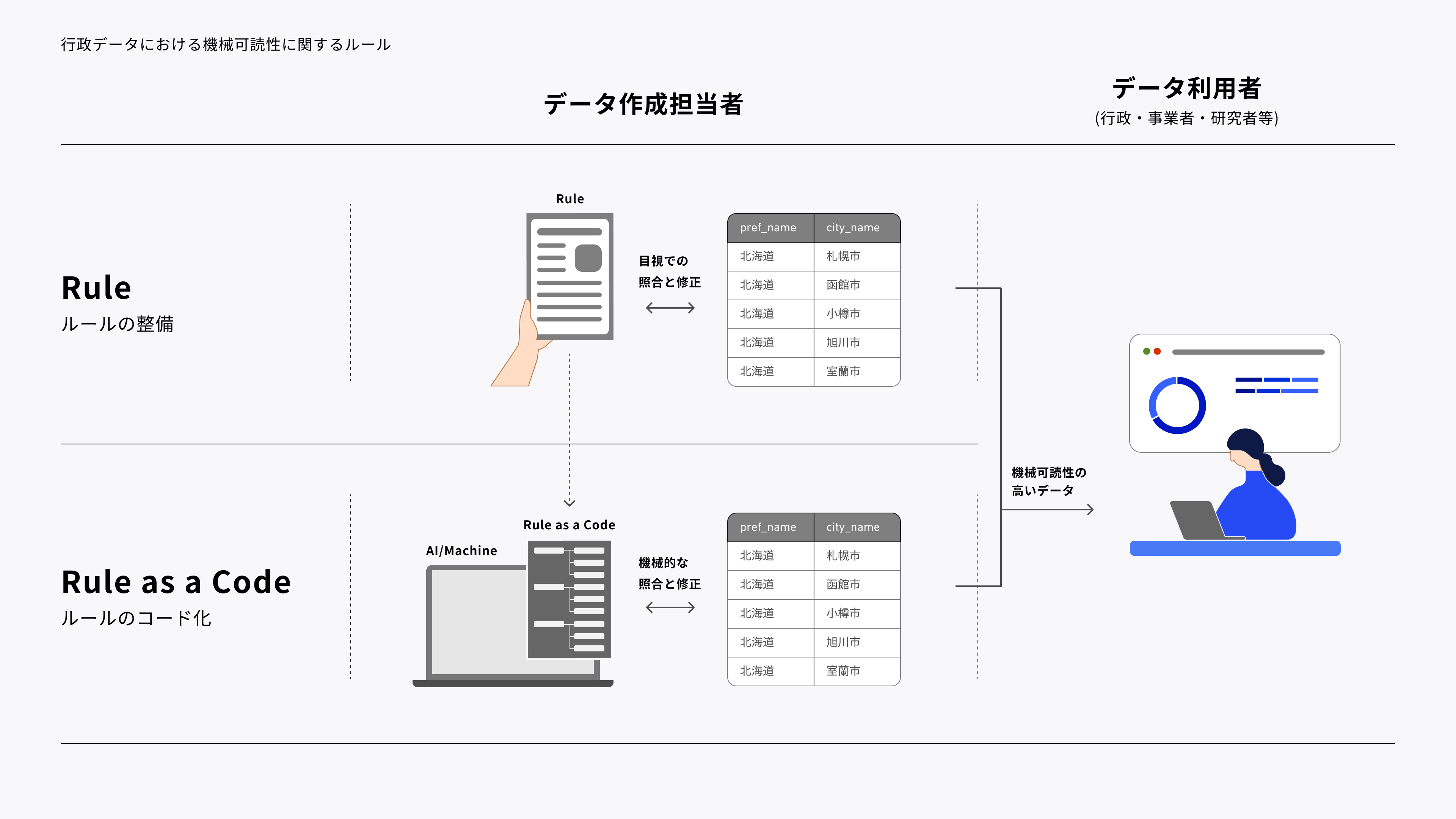
When creating machine-readable data, it is necessary to confirm compliance with rules by taking the following steps.
- 1. Check: Check against the rules and organize the compliance status
- 2. Point out: List the items that need to be corrected according to the target level.
- 3. Modification: The file is modified manually or mechanically.
Code rules
It is effective to automate the repetition of routine tasks, such as the procedure for applying rules, by machine, such as AI. In that case, in order to have a unique check tool or AI tool refer to these rules, it is more useful to describe the rules in a format that is easy for machines to read than a PDF document created for humans. Therefore, the rules themselves are published in a code format with high machine-readability.
3. Download a list of rules and code
A Coded Version of Rules for Machine Readability in Administrative Data
This is a code that organizes the rule structure so that machines can directly read and interpret it. function is done as a "configuration file" when loading it into original checking systems, AI tools, etc.
- Code for Rules on Machine Readability in Administrative Data (JSON format) (GitHub)
- Code for Rules on Machine Readability in Administrative Data (CSV format) (GitHub)
4. Use the Rules Compliance Check Tool
Harunobu, a Machine-Readability and Rule-Compliance Checking Tool
In order to reduce the workload related to data creation and inspection and to streamline the work of rule compliance, Digital Agency has released a judgment tool called "Harunobu" on GitHub. Because it can automatically inspect and score compliance based on the "Rules for Machine Readability in Administrative Data", it is possible to quickly understand which part of the data should be corrected and lead to smooth data improvement without rework.
Please check the following page for details on the function of the tool, how to use it, and the installation procedure.
5. Inquiries
Any questions or ideas should come from , comments and requests, .