
Promotion of the sharing economy
- Last Updated:
With regard to the sharing economy, we will promote initiatives that will lead to further penetration and establishment in society while improving the safety and reliability of services.
Overview
The sharing economy * is expected to promote the use of all kinds of idle assets and contribute to the realization of a society in which each citizen can make choices that meet diverse needs, a society that is resilient to emergencies such as natural disasters and infectious diseases, and a sustainable recycling-oriented society.
In the past few years, new sharing economy services have emerged in various fields, including sharing of vacant rooms and parking spaces, and housekeeping and childcare services. As the digitalization of society as a whole progresses, consumers are increasingly aware of and using these services.
The government and the private sector will work together to promote initiatives aimed at the sound development of the sharing economy, mainly in collaboration with the Sharing Economy Association, a trade association.
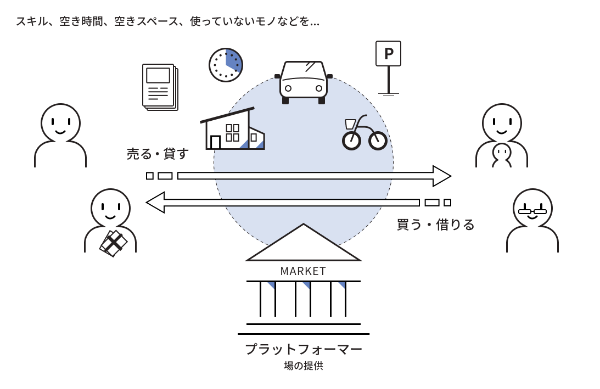
*Sharing economy: Economic revitalization activities that enable individuals to use their assets (including intangible assets such as skills and time) via an Internet matching platform (from the interim report of the Sharing Economy Review Meeting)
Recent Efforts
Handbook on Utilization of the Sharing Economy (March 2022 Edition)
In collaboration with the Sharing Economy Association of Japan, we are promoting initiatives that will lead to the penetration and establishment of the sharing economy in society. As a tool for local governments to consider the use of the sharing economy, the association has released a handbook summarizing the benefits of the sharing economy and key points for its use.
One of the contents is a list of sharing economy services and 35 services from 33 companies that can help solve local problems. You can learn in detail about the outline and features of each service and specific examples of use by local governments.
Meetings, etc.
No information available at this time.
Related Information
Sharing Economy Review Meeting
The Sharing Economy Review Meeting has been held since July 2016, and the Interim Report of the Sharing Economy Review Meeting and the Second Report of the Sharing Economy Review Meeting were compiled and published.
Sharing Economy Review Meeting (Website of the Prime Minister's Official Residence) (https://www.kantei.go.jp/jp/singi/it2/senmon_bunka/kaikaku.html * Currently unavailable)
Sharing Economy Review Meeting Interim Report (PDF / 1,575 kb)
Second Report of the Sharing Economy Review Meeting (PDF / 4,635 kb)
Sharing economy model guidelines and sharing economy certification system
[The sharing economy certification system ended on March 31, 2026.]
The Sharing Economy Model Guidelines specify the items and details that businesses providing sharing economy matching platforms must comply with from the perspective of ensuring safety and reliability. The Sharing Economy Association of Japan, based on the model guidelines, has formulated voluntary rules that will become the standard for the sharing economy industry in Japan, and operates the Sharing Economy Certification System to certify sharing services that meet these rules. Through this initiative, we will continue to raise awareness of the safety and reliability of businesses providing sharing economy matching platforms.
Share-Worker training and certification system, Share Eco-Confidence Test
[The Share Eco Confidence Test was completed on March 31, 2026.]
A scheme to certify share-workers * was discussed at the Sharing Economy Review Meeting and other venues, and the "Basic Concept" of the share-worker training and certification system was formulated. Based on the Basic Concept, the Sharing Economy Association of Japan has been operating the "Sharing Eco-Confidence Certification Test." We hope that having as many people as possible take the test will improve the safe and secure of the entire sharing economy and lead to its sound development.
*Share workers: People who use sharing economy platforms to provide skills, time, etc.
Examples of Sharing Economy Use
TMG has compiled and published a collection of examples of how local governments and municipalities, such as private sector, are using the sharing economy to solve social issues and revitalize the economy in their regions. The 2020 edition includes examples from a total of 115 regions.
Sharing Economy Evangelist
In order to promote the introduction of sharing economy utilization in local areas, human resources with abundant knowledge and utilization results, etc. have been appointed as sharing economy evangelists. Local governments, etc. that wish to dispatch evangelists, such as participating in seminars and lectures for residents, identifying local issues through opinion exchange meetings, and formulating plans up to the introduction of sharing economy, please contact the following contact information.
E-mail: share-eco-center _ atmark _ digital. go. jp
*To prevent spam mail, "@" is displayed as " _ atmark _ ".
When sending mail, please replace " _ atmark _ " with "@" (single-byte).
- Roles and Profiles of Sharing Economy Missionaries (PDF / 1,225 kb) (updated on May 10, 2023)
Sharing City Promotion Council
The Sharing City Promotion Council was established in July 2020 with the aim of solving local problems through the use of the sharing economy. The heads of local governments serve as board members, and Digital Agency participates as a supporter. As of November 2021, more than 70 local governments were participating as members. We are working to create new examples of use, including holding participatory working sessions in line with each issue theme such as "disaster prevention," "SDGs," and "related population."
Anzen and Anshin Sharing Economy Usage Guidebook (published in October 2021, Consumer Affairs Agency)
Consumer Affairs Agency has created a revised version of the pamphlet "How to Walk in a Co-Creating Society: The Sharing Economy," which explains the key points for using sharing economy services in safe and secure (published in November 2019), called the "Guide to the Use of Anzen and Anshin Sharing Economy." The revised version of the pamphlet includes a column that introduces public-private initiatives to use sharing economy services in safe and secure, as well as an enhanced proactive measure for problems.